7.4 (Q1)
CiteScore2024
Q2
Web of Science
Volume & Issue: Volume 8, Issue 7, July 2024, Pages 492-549 
Number of Articles: 4

Syntheses and Structural Investigation of Two Novel Lanthanum Complexes with Salen Ligands Derived from 1,2-Diaminopropane and Ethylenediamine with 3-Methoxysalicylaldehyde

Pages 492-503

https://doi.org/10.48309/chemm.2024.458988.1798

Mohammad Hakimi, Mohammadreza Fotouhi Ardakani, Alireza Mazloumi Bajestani

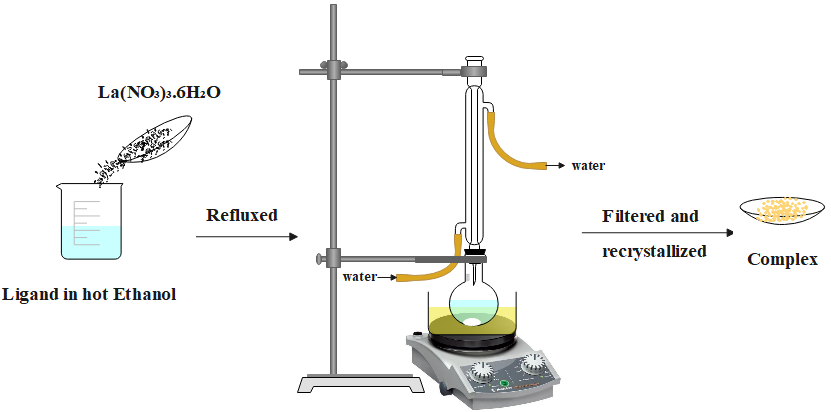
Abstract Recently, the chelation chemistry of Schiff base lanthanide (III) complexes has been widely considered. This work has concentrated on novel types of binuclear lanthanum complexes derived from two salen ligands including N,N′-bis(3-methoxysalicylaldehyde)-1,2-diaminopropane (H2La) and N,N′-bis(3-methoxysalicylaldehyde)-ethylenediamine (H2Lb). The salen ligands have been formed by the precipitation of ethylenediamine and 1,2-diaminopropane with 3-methoxysalicylaldehyde. Different analytical methods have been used for the characterization of prepared compounds in particular elemental analysis, UV-Vis, FT-IR, 1H-NMR, and 13C-NMR spectroscopy. The bidentate behavior of two salen ligands was suggested based on spectral studies. According to the spectral results, the proposed coordination of two salen ligands and their lanthanum complexes was approved.
Efficient Synthesis of 3,4-Dihydropyrimidin-2(1H)-ones Catalyzed by a Cd-Based Covalent Organic Framework Under Solvent-Free Conditions

Pages 504-520

https://doi.org/10.48309/chemm.2024.464210.1806

Maryam Nazifi, Hamid Saeidian, Salman Taheri

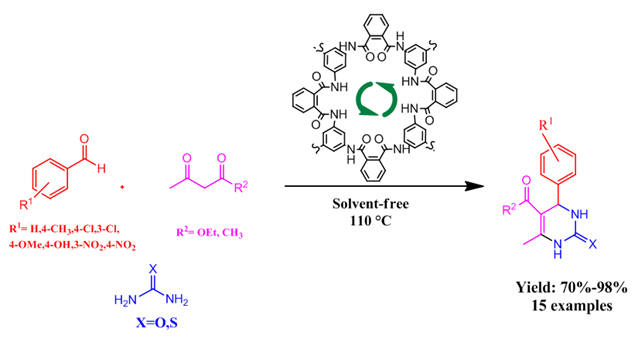
Abstract A porous covalent organic framework (COF) was synthesized through the condensation reaction of melamine and phthalic acid and Cadmium acetate was then incorporated into the COF through a straightforward post-treatment. Cd-COF as a catalyst was assessed in the one-pot three-component Biginelli-type reaction, involving aldehydes, β-diketones, and urea. It demonstrated exceptional activity and selectivity, promoting the environmentally friendly synthesis of various 3,4-dihydropyrimidin-2(1H)-ones without organic solvents. Characterization using FT-IR, SEM, EDS, PXRD, TGA, and1H-NMR analysis provided valuable insights into the catalyst’s structure and properties. This method is categorized by its effective catalyst, straightforward workup process, uncomplicated separation that does not require chromatography, and the ability to reuse Cd-COF up to four times. These key aspects underscore the significance of this approach, which is expected to be extensively applied in both academic and industrial research.

Highly Stable Gold Nanoparticle Functionalized by Aspirin in an Aqueous Solution: Evaluation of Its Stability at Different Temperatures and pH Values

Pages 521-537

https://doi.org/10.48309/chemm.2024.467792.1811

Wanisa Abdussalam-Mohammed, Amna Qasem Ali, Moussa Khlifa, Otman Otman, Aboubaker A. Elhadi

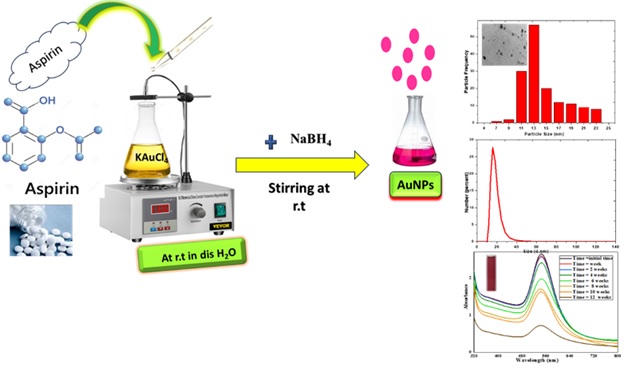
Abstract Aspirin, also called O-acetylsalicylic acid (ASA), was used to functionalize gold nanoparticles (AuNPs), resulting in a well-dispersed aqueous solution with stability maintained for over 3 months in this study. The stability, size, and shape of the formed AuNPs were investigated using UV-Visible spectrophotometer (UV-Vis), transition electron microscope (TEM), and dynamic light scattering (DLS). The functional groups capping AuNPs were investigated by Fourier Transform infrared spectroscopy (FTIR). In this work, AuNPs were spherical with an average diameter of 13 ± 1.2 nm. The UV-Visible results showed a strong SPR peak around 544 nm. In addition, the behaviour of aspirin-AuNPs in aqueous medium within different pH values (pH 1.8 – 11.3), and chemical stability with time, and various temperature values (25 °C, 40 °C, 60 °C, and 70 °C) were carried out in this study. The first goal of this work is to prepare AuNPs with good stability using aspirin as a capping ligand in the presence of NaBH4 to control size distribution and prevent any aggregation of AuNPs. Second, to ascertain the pH and temperature values at which the AuNPs will become unstable. Overall, aspirin is a weak acid that is only slightly soluble in water. Therefore, AuNPs lead to a significant increase in its solubility, which is another important issue for drug solubility nowadays. Accordingly, aspirin can be used at the lowest possible dose using AuNPs in the future.

Improvement of TiO2/Au/FTO Conversion Efficiency in Dye-Sensitized Solar Cells Ready via Beetroot Plant Extract

Pages 538-549

https://doi.org/10.48309/chemm.2024.468654.1812

Sinan Mohammed Hasan, Wissem Cheikroho Koubaa, Alaa Jabbar Ghazai

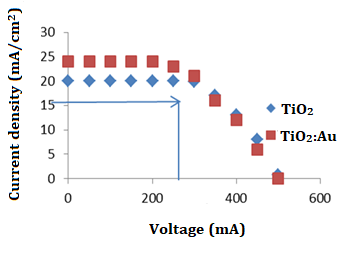
Abstract In recent years, natural plants, especially beetroot, have been used as a natural photon dye to fabricate and enhance the efficiency of dye-sensitised solar cells (DSSC) due to their unique properties such as cost-effectiveness, simpler extraction process, environmental friendliness, sustainability, performance characteristics, etc. This study investigates the addition of gold nanoparticles to TiO2, which was chemically produced by extracting beetroot leaves. Transmission electron microscopy and XRD were used to characterise the TiO2 and TiO2:Au nanoparticles. The results of these analyses indicate that the pure TiO2 powder contains both the rutile and anatase phases. Rutile TiO2 has a rod-shaped shape, and the crystallite size was 20-40 nm, while the crystallite size range of anatase was only spherical. TiO2:Au nanoparticles are rod-shaped. Using UV-Vis spectroscopy, the optical properties of TiO2 and TiO2:Au nanoparticles were determined. The results showed that the gold nanoparticles exhibited surface plasmon resonance and contributed to the improvement of optical properties by increasing the quantum confinement of carriers within the structure, which can improve the light absorption and overall performance of photovoltaic systems. Photovoltage and photocurrent measurements were used to evaluate the performance of the TiO2/Au/FTO-doped solar cells. Increasing the surface-to-volume ratio and replenishing the electron-hole pairs of the solar cells using gold nanoparticles resulted in a 12% increase in solar-to-electrical efficiency compared to pure TiO2.