7.4 (Q1)
CiteScore2024
Q2
Web of Science
Volume & Issue: Volume 8, Issue 8, September 2024, Pages 550-590 
Number of Articles: 4

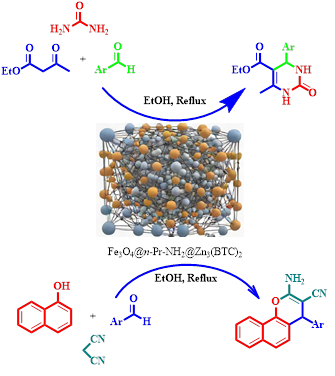
Design and Characterization of Fe3O4@nPr-NH2@Zn3(BTC)2 Magnetic MOF : A Catalyst for Dihydropyrimidine and 2-Amino-4H-Chromene Synthesis

Pages 550-568

https://doi.org/10.48309/chemm.2024.472969.1817

Sami Sajjadifar, Farhaneh Abakhsh, Zeinab Arzehgar

Abstract In this study, a novel Fe3O4@nPr-NH2@Zn3(BTC)2 magnetic metal-organic framework (MOF) was synthesized and thoroughly characterized using a range of analytical techniques, including Fourier transform infrared spectroscopy (FTIR), energy dispersive X-ray spectroscopy (EDS/EDX), thermogravimetric analysis (TGA), and vibrating sample magnetometry (VSM). The morphology of the magnetic MOF was also examined using scanning electron microscopy (SEM). This magnetic MOF demonstrated excellent catalytic performance in the synthesis of dihydropyrimidines and 2-amino-4H-chromene derivatives under ethanol solvent and reflux conditions. Notably, the catalyst showcased impressive recyclability, maintaining its catalytic activity over five cycles without any significant loss in efficiency.
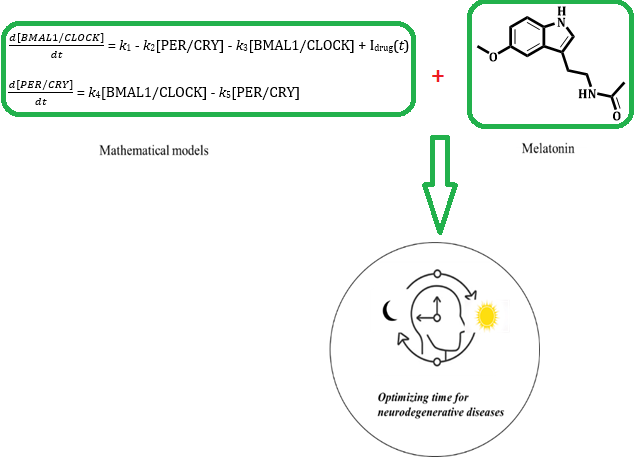
Molecular and Mathematical Models in Parkinson’s and Alzheimer’s Diseases: Optimizing the Timing of Drugs

Pages 569-584

https://doi.org/10.48309/chemm.2024.474669.1820

Emine Erdag

Abstract Circadian rhythms, which regulate various physiological processes, play a significant role in neurodegenerative diseases. This study utilized a detailed mathematical modeling approach to optimize the timing of drug administration for Alzheimer's and Parkinson's medications. The term "optimize the timing of drug administration" refers to the process of determining the most effective dosing schedules based on circadian rhythms. Optimization was defined by aligning drug administration times with the body's natural circadian rhythms to maximize therapeutic efficacy and minimize side effects. Criteria for "optimal dosing schedules" included achieving peak drug concentrations during key periods of circadian protein activity and aligning dosing times with the body’s biological clock. The models integrated pharmacokinetic and pharmacodynamic data with the dynamic interactions of core circadian clock proteins (BMAL1/CLOCK and PER/CRY) through ordinary differential equations (ODEs). These equations simulated the concentration of these proteins and drugs over time, allowing for the prediction of optimal dosing schedules that align with the body's natural circadian rhythms. The addition of melatonin demonstrated potential benefits. AutoDock Vina and GROMACS software were used for molecular docking simulations. For Alzheimer's disease, simulations identified that Donepezil achieves maximum efficacy when administered at midnight, Memantine in the morning, and Rivastigmine at noon. In Parkinson's disease, Levodopa was most effective when administered in the morning, Pramipexole at noon, and Rasagiline in the evening. Combining these drugs with melatonin resulted in further stabilization of circadian protein levels and extended the therapeutic effects of the drugs. Binding energies for all drug molecules were lower than for melatonin in each clock protein complex, indicating that melatonin could enhance therapy. These findings provide a strong basis for future clinical studies to validate time-optimized pharmacotherapy as a strategy to improve the management of Alzheimer's and Parkinson's diseases.

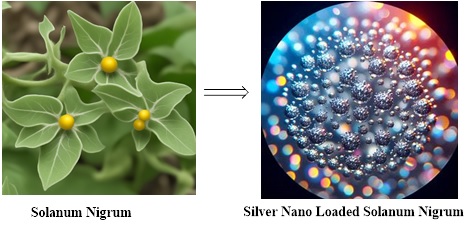
Silver Nano Loaded Solanum Nigrum with Potential Biological Activities

Pages 585-602

https://doi.org/10.48309/chemm.2024.470323.1813

Muhanad Najm Abdullah, Mehdi El Arbi

Abstract Cancer is still one of the major causes of death in all over the world. Plants with potent biological activities are on the hunt. Silver nanoparticles (AgNPs) are used in studying and determining therapeutic targets for cancer cells. This study aims to evaluate the silver nanoloaded Solanum nigrum (S. nigrum) extract for its potential biological activities, particularly on cancer cells. S. nigrum leaves were extracted and synthesized using AgNPs and sliver nitrate (AgNO3). Chemical and cytotoxic analyses, as well as antimicrobial activity and 2,2-diphenyl-1-picrylhydrazyl (DPPH) free radical activities, were conducted on the extract. Four different molarities (1, 1.5, 2, and 2.5 mM) and six concentrations (2.5, 5, 10, 20, 40, and 80 µg) were tested. The study reveals that S. nigrum extract had a high content of flavonoids, saponins, and phenols, suggesting potential antioxidant properties. The DPPH radical scavenging activity decreases with concentration due to the abundance of flavonoids and phenols. The extract had a greater effect on gram-positive bacteria than gram-negative bacteria. The cytotoxicity effect on cell viability was significant, with lower cytotoxicity and higher activities for caspase-8 and caspase-9 enzymes. The findings indicate that S. nigrum extract had a significant effect on cancer cells. Future research could validate AgNPs' anticancer and antimicrobial activities by testing higher concentrations on cancer cells and analysing other phytochemical contents of S. nigrum extract.

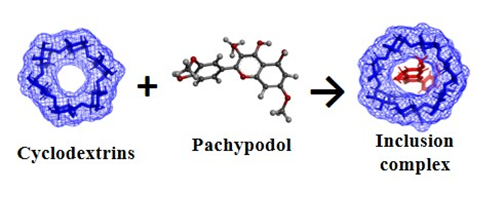
Inclusion Complexes of Pachypodol with Unmodified and Modified Cyclodextrin Nanocarriers: Theoretical Studies

Pages 603-625

https://doi.org/10.48309/chemm.2024.466929.1809

Abbas Heshmati Jannat Magham, Seyyedeh Mahnaz Naseri Baygi

Abstract This study investigates the potential of alpha-, beta-, and gamma-cyclodextrins (α-CDX, β-CDX, and γ-CDX) and amino-, hydroxypropyl-, and random methyl-β-CDX (HPβ-CDX, AMβ-CDX, and RMβ-CDX) to enhance the water solubility, bioavailability, and stability of pachypodol (PAC) as with anticancer, antiviral, antimicrobial, anti-inflammatory, and antioxidant properties. Computational methods, e.g., molecular docking and molecular dynamics (MD) simulation methods, were utilized to analyze the CDXs: PAC ICs. The results show that the formation of a stable inclusion complex (IC) between HPβ-CDX and PAC is evident according to the molecular docking analysis. Furthermore, the insertion of PAC into the CDX cavities led to a decrease in the radial distribution function (RDF) graphs and a reduction in hydrogen bond numbers within the CDX cavities, compared with the free CDXs. HPβ-CDX exhibited the maximum number of hydrogen bonds with solvents because of its hydroxypropyl substituent. Furthermore, in keeping with molecular docking, the result of interaction energy revealed that Van der Waals (VDW) interaction and hydrogen bonding play a vital role in the CDXs: PAC IC formation. These results demonstrate the potential of both natural and modified CDXs as excipients to enhance the PAC's stability, bioavailability, water solubility, and therapeutic activities.