7.4 (Q1)
CiteScore2024
Q2
Web of Science
Volume & Issue: Volume 8, Issue 9, September 2024, Pages 626-712 
Number of Articles: 4

Benzimidazolium Dihydrogen Phosphate: A Novel Green Catalyst for the Preparation of Pyrano[2,3-d]pyrimidines and Pyrano[3,2-c]chromenes in Aqueous Media

Pages 626-644

https://doi.org/10.48309/chemm.2024.457715.1796

Zahra Azizi, Sara Haghpanah-Kouchesfahani, Safiullah Nawabi, Nader Daneshvar, Frahad Shirini, Hassan Tajik

Abstract In this study, a novel benzimidazole-based Brönsted acidic ionic salt, benzimidazolium dihydrogen phosphate, was synthesized and characterized using Mass spectrometry, FT-IR and NMR spectroscopy, as well as ICP analysis. The salt demonstrated efficient catalytic properties and reusability in the production of pyrano[2,3-d]pyrimidine and pyrano[3,2-c]chromene derivatives. Noteworthy advantages of this approach include the minimal catalyst requirement, straightforward work-up process, brief reaction duration, high yields, and catalyst reusability for four consecutive uses without a significant decrease in efficiency.
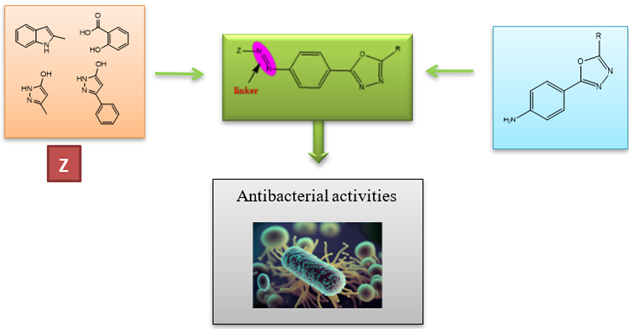
Synthesis of a New Series of 1,3,4-Oxadizole-Based Azo Derivatives and In Vitro Evaluation of their Antibacterial Activities

Pages 645-661

https://doi.org/10.48309/chemm.2024.474180.1819

Farzaneh Yazdan Kushkoo, Hojatollah Khabazzadeh, Moj Khaleghi

Abstract A new series of 1,3,4-oxadizole-containing azo derivatives were synthesized in this research. The structural properties of the newly-synthesized compounds were assessed by IR and 1H- and 13C-NMR spectroscopic techniques. The antibacterial properties of the synthesized azo compounds were evaluated against Gram-negative and Gram-positive bacteria in vitro, revealing broader antibacterial spectrum on both bacteria groups for derivatives containing indole ring. In particular, most compounds had antibacterial effects on Staphylococcus aureus (ATCC 25923), while Pseudomonas aeruginosa (ATCC 27853) exhibited resistance against all azo compounds.

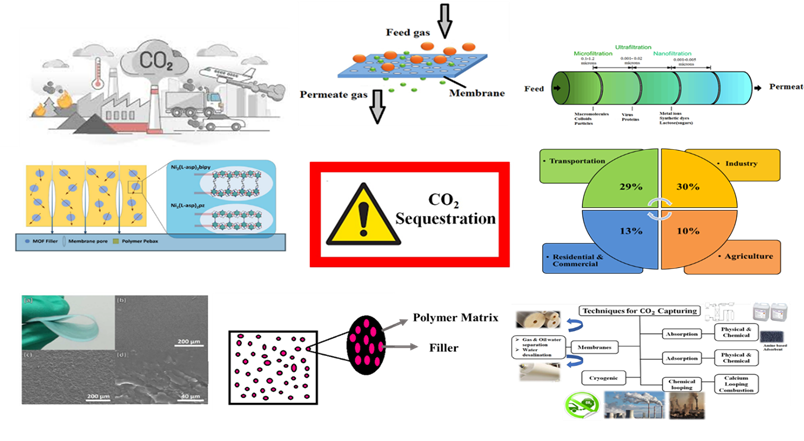
A Critical Review on Membrane Technology and Its Application in CO2 Capturing

Pages 662-698

https://doi.org/10.48309/chemm.2024.473209.1818

Nida Fatima, Hizba Waheed, Ayesha Raza, Amir Mukhtar, Fawad Ahmad

Abstract CO2 emission resulting from rapid urbanization and industrialization is a significant contributor to global climate change, resulting from the burning of fossil fuels such as coal, oil, and natural gas. Approximately two billion tons of CO2 are released annually by all of the coal-fired power plants that are still in operation today. Various strategies that have been implemented to reduce CO2 emissions includes energy efficiency, renewable energy, carbon capture and storage. Membrane technology has emerged as a promising solution for CO2 capture and is currently being investigated for CO2 capture from power plant emissions due to their fundamental engineering and cost effectiveness over competing separation technologies. This technology involves the use of selective membranes that allow the separation of CO2 from gas mixtures such as flue gas, natural gas, and biogas. The performance of the membranes can be enhanced through the use of advanced materials, surface modification, and process optimization. The aim of this study is to review the literature on the recent advancements made in Membrane technology and its application in reducing CO2 emissions from the past few years.

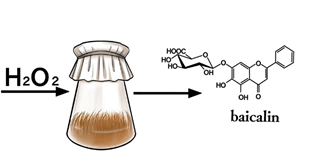
Specific Features of Changes in the Content of Basic Flavones in Scutellaria Przewalskii Juz. Hairy Root Culture under the Action of Hydrogen Peroxide

Pages 699-712

https://doi.org/10.48309/chemm.2024.471727.1815

Anna Yurievna Stepanova, Solov’eva Aleksandra Ivanovna, Yuri Mikhailovich Panov, Dmitrii Andreevich Matalin, Evgeny Aleksandrovich Gladkov

Abstract Representatives of the genus Scutellaria are perennial plants, which root extracts are widely used in oriental medicine, as they have a wide range of pharmacological effects on living organisms due to the presence of five flavones: chrysin, glucuronides – baicalein, wogonoside, and their aglycones – baicalein and wogonin. Scutellaria przewalskii Juz. is a poorly studied species of the Scutellaria family, a Tien Shan endemic. Reactive oxygen species (ROS) are produced under conditions of both biotic and abiotic stresses, which cause damage to cell structures. The aim of the present study was to examine the effect of ROS on the content of flavones, which may help uncover their role in protecting the root from damage. We used hairy roots of Scutellaria przewalskii. Hydrogen peroxide of two concentrations 1 and 10 mM was used as an inducer of oxidative stress. The highest flavones content was observed on the 1st and the 7th day of cultivation at 10 mM concentration of hydrogen peroxide. It was equal to 49.3 and 50.8 mg/g of dry weight respectively which was 1.9-3.0 times higher than the control sample. The change was caused by an increase in the content of glucuronides, primarily baicalin, suggesting its essential role in root adaptation to oxidative stress.