7.4 (Q1)
CiteScore2024
Q2
Web of Science
Volume & Issue: Volume 8, Issue 10, October 2024, Pages 713-775 
Number of Articles: 4

Formaldehyde Emission-Correlation between Different Standard Methods in Three Different Panel Products

Pages 713-732

https://doi.org/10.48309/chemm.2024.474248.1821

Mamatha Baballi Sheshagir, Sujatha Dhanpal, Ranjana Yadav, Sadhu Charan Sahoo, Vinod Kumar Upadhyay

Abstract Wood based panel products are produced mostly using formaldehyde-based adhesives.   Formaldehyde being carcinogenic thus needs risk assessment from these panel products.  The formaldehyde emissions are investigated by different methods and accordingly are adopted by different countries. It is important to understand the relationship between these different test methods. Indian standard particle board [IS 3087] and medium density fiber board (MDF) [ IS 12406] stipulate the measurement of formaldehyde emissions from wood-based panels shall be carried out in accordance with the IS/ ISO/12460 1 m3 climate chamber method or IS 13745 perforator method. Thus, a study on correlation of formaldehyde emission between chamber method 1m3 as per ISO/IS 12460, desiccator method JIS 1460 A, AS/NZ, and perforator method as per EN-120 and IS 13745 were carried out for plywood, particle board and medium density fiber board. The results showed a good positive correlation between the chamber (y) and desiccator (x) method irrespective of type of the panels tested. For plywood the linear relationship y = 0.155x + 0.0053 between the chamber and desiccator method of testing with R2 of 0.845.  The equation of the correlation for particle board and MDF is y = 0.0787x + 0.0582 and y = 4.4899x - 0.0221, respectively, with R2 0.75. This study demonstrated the practical applicability between a relatively inexpensive formaldehyde content perforator method (EN 120) and formaldehyde emission desiccator method JIS 1460 A with the more expensive chamber method. Insignificant differences were observed between measured and transformed values between chamber and desiccator method.
Novel Sulbactam Combinations Against Multidrug-Resistant Acinetobacter Baumannii

Pages 733-744

https://doi.org/10.48309/chemm.2024.483306.1838

Emine Erdag

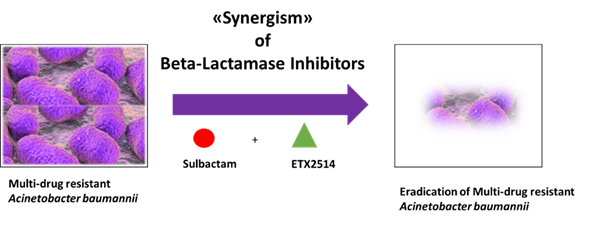
Abstract Multidrug-resistant (MDR) Acinetobacter baumannii poses a critical threat in healthcare settings due to its capacity to evade commonly used antibiotics, particularly through the production of various beta-lactamases. Sulbactam, a beta-lactamase inhibitor with intrinsic bactericidal activity, often requires combination with beta-lactamase inhibitors to restore efficacy. This study investigates the synergistic potential of combining Sulbactam with novel inhibitors—Durlobactam, Avibactam, and ETX2514—against Class A, Class C, and Class D beta-lactamases. Molecular docking, molecular dynamics (MD) simulations, and MM/PBSA binding energy calculations were performed to evaluate the binding affinities of the inhibitors to their respective beta-lactamases. The Chou-Talalay method was applied to assess synergy by calculating Combination Index (CI) values, with CI < 1 indicating synergy. Durlobactam + Sulbactam demonstrated superior synergy compared to other combinations, with a CI of 0.62 against Class D, while ETX2514 + Sulbactam exhibited broad-spectrum synergy across all beta-lactamase classes (CI < 0.80). Avibactam + Sulbactam showed limited synergy against Class D enzymes (CI = 1.09) but remained effective against Class A and Class C beta-lactamases. The molecular dynamics and MM/PBSA calculations supported these findings, with ETX2514 and Durlobactam showing superior binding stability in the active sites. This study demonstrates the potential of Durlobactam and ETX2514 as highly effective beta-lactamase inhibitors when combined with Sulbactam, particularly against Class D beta-lactamases in MDR Acinetobacter baumannii. These findings highlight the importance of selecting appropriate inhibitors to restore antibiotic efficacy and suggest Sulbactam + ETX2514 as a promising therapeutic option for MDR infections.

Synthesis Nickel (II) and Copper (II) Complexes with a New Oxazoline Ligand, Bis 2-(2-Phenyl-2-(pyridin-2-yl) Oxazolin-3-yl)ethanol

Pages 745-752

https://doi.org/10.48309/chemm.2024.479911.1829

Reihaneh Beiraghi Toosi, Mohammad Hakimi

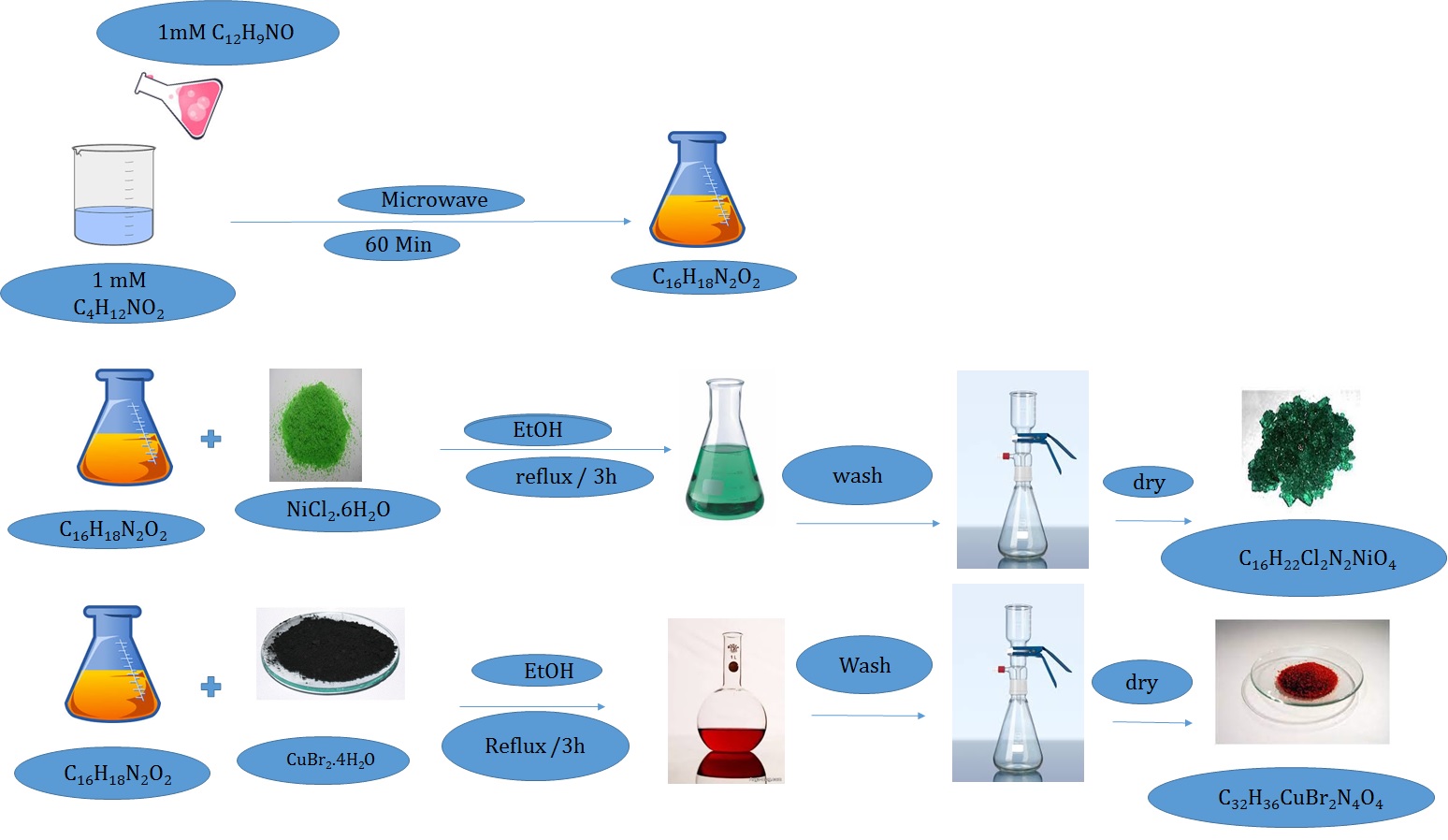
Abstract In this study, a new oxazoline derivative containing 2-phenyl-2-(pyridine-2-yl) oxazoline-3-yl)ethanol (POE) was synthesized from the solvent-free reaction of diethanolamine with 2-benzoylpyridine under microwave conditions. The POE ligand can coordinate to the metal through the amino and pyridine nitrogen atoms. The complexes [Ni(POE)Cl2(H2O)2] and [Cu(POE)2Br2] were synthesized from the reaction of the POE ligand with nickel chloride hexahydrate and copper bromide tetrahydrate, respectively. These complexes were characterized by elemental analysis, FT-IR, UV-Vis, conductivity, and melting point methods. Elemental analysis of the [Ni(POE)Cl2(H2O)2] and [Cu(POE)2Br2] complexes indicates that the POE to nickel and copper metal ratio is 1:1 and 1:2, respectively. In the FT-IR spectrum of the POE ligand, the stretching vibration of C=O in the starting materials 2-benzoylpyridine and NH2 in diethanolamine are absent, and a new C=N stretching vibration is observed. The vibrational bands of Ni-O, Ni-N, and Ni-Cl in the [Ni(POE)Cl2(H2O)2] complex and Cu-Br and Cu-N in the [Cu(POE)2Br2] complex are observed. The electrical conductivity of the complexes indicates that they are neutral.

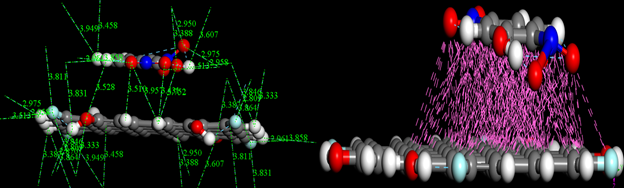
Adsorption of some Nitrophenols onto Graphene and Functionalized Graphene Sheets: Quantum Mechanics Calculations, Monte Carlo, and Molecular Dynamics Simulations

Pages 753-775

https://doi.org/10.48309/chemm.2024.477565.1825

Tayebeh Hadadi, Mehdi Shahraki, Pouya Karimi

Abstract Adsorption of some nitrophenols as significant environmental pollutants was investigated on pristine graphene and functionalized graphene sheets with O–H···F groups via quantum mechanical calculations, molecular dynamics, and Monte Carlo simulations. Energy data, structural parameters, electronic properties, electron charge densities, molecular electrostatic potential maps, charge transfer, density of states plots, non-covalent interactions, and adsorption isotherms were surveyed to get the possibilities of the selected adsorbents for the adsorption of nitrophenols. Molecular dynamics simulations disclosed that the hydrogen bonding and van der Waals interactions effectively assist to stability of the adsorbate-adsorbent pairs. Average binding energy of the pairs includes nitrophenols in closed and open form with adsorbents is 21.45 and 38.19 kcal mol-1, respectively. Also, sum of electron charge density values at bond critical points that formed between nitrophenols in closed and open form with adsorbents is 42.03 and 43.54 au, respectively. The aromaticity of the central rings of the graphene and functionalized graphene is 0.0487 and 0.0482 au, respectively. Decrease of aromaticity at central rings of both adsorbates and adsorbents is followed by increase of binding energy values of the pairs. Energy decomposition analysis indicate that average electrostatic energy of the pairs include nitrophenols in closed and open form with adsorbents is -14.08 and -14.32 kcal mol-1, respectively. Results suggested that the pristine graphene and functionalized graphene would be suitable adsorbents for adsorption of nitrophenols.