7.4 (Q1)
CiteScore2024
Q2
Web of Science
Volume & Issue: Volume 9, Issue 3, March 2025, Pages 158-250 
Number of Articles: 5

An Electrochemical Sensor Based on SnSe Nanosheets and Ionic Liquids for The Selective Detection of N-acetylcysteine

Pages 158-171

https://doi.org/10.48309/chemm.2025.500065.1882

Peyman Mohammadzadeh Jahani, Reza Zaimbashi, Hadi Beitollahi, Somayeh Tajik

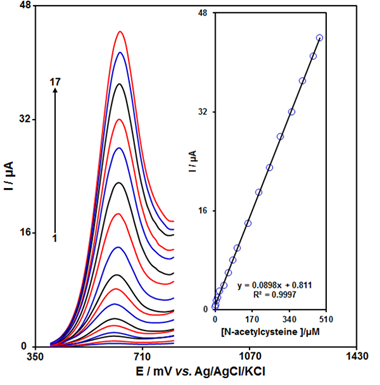
Abstract To detect N-acetylcysteine (N-AC), a voltammetric sensor was developed employing a carbon paste electrode (CPE) modified with SnSe nanosheets (SnSe NSs) and ionic liquids (ILs). Compared to the unmodified CPE, the electrochemical sensor (SnSe NSs/ILs/CPE) exhibited significantly higher current responses for N-AC oxidation. Using linear sweep voltammetry (LSV), cyclic voltammetry (CV), chronoamperometry, and differential pulse voltammetry (DPV), the electrochemical properties of the sensor and the oxidation behavior of N-AC were investigated. With a detection limit (LOD) of 0.02 µM (S/N = 3), DPV, a sensitive analytical method for N-AC quantification, showed a linear relationship between N-AC concentration and peak current spanning the range of 0.05 µM to 480.0 µM. In addition, the sensor demonstrated adequate stability and repeatability. With recovery rates ranging from 91.40% to 106.30%, it was effectively used to determine N-AC in actual samples.
Topological Descriptor Analysis with Chemical Graph Theory Insights and Predicted ADME Data Analysis for Pentafluorophenylurea-Based Pyridine Derivative

Pages 172-189

https://doi.org/10.48309/chemm.2025.502403.1887

Venkata Shivakumar Remella, Haridharan Neelamegan

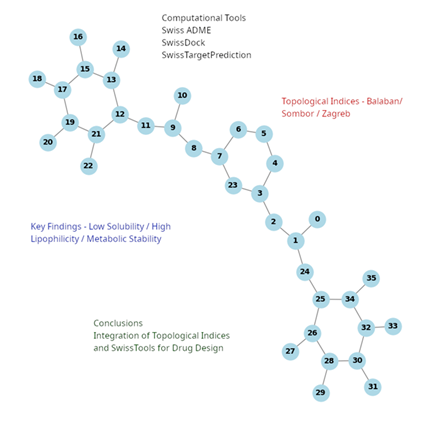
Abstract The compound N, N'-Pyridine-2,6-diylbis-[3-(pentafluorophenyl) urea] (PDPF) was synthesized [CCDC Deposition number:2385135] and characterized using Single Crystal XRD and FT-IR techniques. Structural analysis confirmed intra-molecular and inter-molecular hydrogen bonding, with crystal data revealing a triclinic system and space group Pī. This study delves into the structural and chemical properties of the title compound, N, N'-Pyridine-2,6-diylbis-[3-(pentafluorophenyl) urea], also known as 1-(perfluorophenyl)-3-(6-(3-(2,3,4,5,6-pentafluorophenyl) ureido) pyridin-2-yl) urea, through the lens of Chemical Graph Theory and a diverse set of topological indices. By calculating and analysing 16 distinct topological descriptors, this research offers a comprehensive perspective on the compound's molecular topology, electronic distribution, and potential chemical behaviour. To validate the predictive power of these descriptors, data from advanced bioinformatics tools like SwissADME, SwissSimilarity Ranking, and SwissTargetPrediction were integrated, providing a robust framework for understanding the compound's chemical and biological properties. Specifically, the SwissADME tool is used to predict ADME properties like solubility, lipophilicity (LogP), and drug-likeness, while SwissDock provides docking scores to evaluate the compound’s binding affinities. In addition, SwissTargetPrediction is employed to assess potential biological targets and bioactivity profiles. Our findings show good qualitative correlations between the topological descriptors and the predicted ADME properties, and biological targets, demonstrating the power of Chemical Graph Theory in predicting molecular behaviour. The results also suggest that some indices such as the Wiener Index, Randic Index, and Zagreb Indices are particularly effective at predicting lipophilicity and bioactivity, while the Balaban Index and Hyper-Wiener Index are more closely linked with the compound’s docking interactions. This study provides a novel approach by integrating graph-theoretical descriptors with modern computational tools, offering a theoretical framework that can be further developed in future studies for drug design and molecular optimization. We wish to place on record that this is the first study of its kind for the title compound.

Design and Calculation of a Chlorinated Container to Prevent Oil Production

Pages 190-207

https://doi.org/10.48309/chemm.2025.500944.1885

Hussam Elddin Nabeih Khasawneh, Shakiba Sharifi Tashnizi, Hamid Reza Hanif, Sahar Aflaki, Fatemeh Vakili

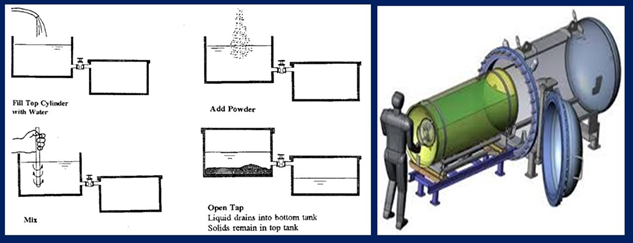
Abstract One of the most important problems in the catalyst regeneration operational units of refineries and petrochemical complexes is the presence of water and chlorine above the permissible limit in the hydrogen produced from these units. The aim of this article is to remove green gum material in the hydrogen gas produced from the reduction vessel. The novelty of present study is the removal rate of hydrogen produced increased from 700 ppm to 710 ppm which is unparalleled in the licensing of French companies. In this study, the possibility of removing water and chlorine was studied and finally, concerning the removal of oil formed from the unit output, the method proposed in this paper was proposed and implemented as an operational method in the catalyst regeneration unit. The results of the process simulation using Aspen software (version 1.10) showed that the chlorine present in the unit output has decreased from 1100 ppm before the changes to less than 10 ppm after the process changes. Likewise, water has decreased from 2150 ppm before the changes to 100 ppm. Due to these changes, the HCl present in the outlet was 198 ppm and it reduced the outlet pH to 4.4 and created a completely acidic environment with high corrosiveness. By completely removing the HCl, the outlet pH increased to about 9.6 and the corrosion rate of the unit outlet decreased significantly. It should be noted that applying these changes to the process increased the purity of the produced hydrogen and as a result, its amount increased from 700 ppm to 710 ppm, or in other words, the production rate increased from 20 ton/hr to 22 ton/hr.

Phthalate-Functionalized Hyperbranched Glycerol Polyester Nanocopolymer: Synthesis, Characterization, and Malachite Green Dye Adsorption Efficiency

Pages 208-232

https://doi.org/10.48309/chemm.2025.504000.1891

Ammar Abdulkareem Saadi, Heshmatollah Alinezhad, Mahmood Tajbakhsh, Mohammad N. Al-Baiati

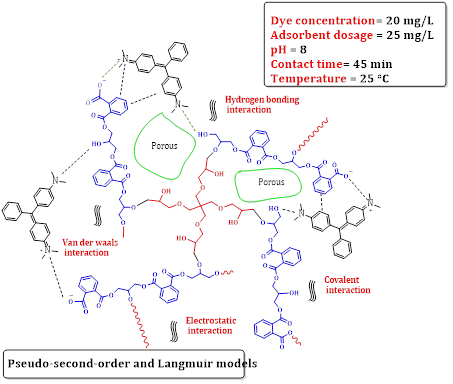
Abstract The study reports the successful synthesis of PHBGP, a phthalate-functionalized hyperbranched glycerol polyester nano copolymer, notable for its functional activity and porosity. Pentaerythritol glycidyl ether (PEGE) was synthesized and utilized to enhance the harmonious growth of the prepared hyperbranched nanocopolymer PHBGP. Characterization methods including 1H-NMR, 13C-NMR, FT-IR, AFM, and XRD validated its structural properties. As a nano adsorbent, PHBGP effectively adsorbate Malachite Green dye under optimal conditions: 20 mg/L dye concentration, 25 mg/L adsorbent dosage, pH 8, and 25 °C. Isotherm models, especially the linear Langmuir model (R²=0.9946), demonstrated a maximum adsorption capacity of 666.7 mg/g, implying that the adsorption occurs in a monolayer on consistent active sites. The Freundlich model's n value of 3.152 indicates a favorable adsorption process with heterogeneous surfaces. The experimental data closely aligns with the pseudo-second-order model with the R2 value of 0.9993. The thermodynamic study explains that ΔG < 0, ΔH > 0, and ΔS > 0. After completing six consecutive cycles, PHBGP attained an adsorption rate of 89.92% for the MG dye. The adsorption mechanism involves hydrogen bonding, ionic interactions, π-π interactions, and pore-filling. Overall, PHBGP demonstrates potential as a highly effective and environmentally friendly adsorbent for the removal of MG dye.

Synthesis of TiO2-ZnO Nanocomposites and Evaluation of their Antibacterial and Antifungal Activities: Effect of Calcination Time

Pages 233-250

https://doi.org/10.48309/chemm.2025.492900.1859

Adil Kadum Shakir, Ebrahim Ghanbari-Adivi, Aref S. Baron, Morteza Soltani

Abstract Nanomaterials have significantly transformed multiple scientific and technological fields due to their exceptional properties, which result from their quantum confinement effects and high surface-to-volume ratios. Among these materials, zinc oxide (ZnO) and titanium dioxide (TiO2) nanoparticles have attracted considerable interest because of their diverse applications.
In this study, TiO2-ZnO nanocomposites were synthesized using varying calcination times of 1, 1.5, 2, 2.5, and 3 hours. Characterization of fabricated samples through X-ray diffraction (XRD)‌ spectroscopy, Fourier transform infrared (FTIR) spectroscopy, field emission scanning electron microscopy (FESEM), and energy-dispersive X-ray spectroscopy (EDXS) confirmed the successful fabrication of the nanocomposites. In this regard, XRD analysis revealed anatase TiO2 and hexagonal wurtzite ZnO phases. Raman spectroscopy also supported these findings, identifying characteristic peaks of both TiO2 and ZnO.
The calcination time had a minimal effect on the crystal structures and also morphology of the nanocomposites, which gave rise to its negligible impact on optical properties and biological activities of the samples. Optical properties assessed by means of UV-visible and photoluminescence (PL) spectroscopy showed consistent band gap absorption and emission profiles across all samples, among which the nanocomposite calcined for 1 hour exhibited the best optical properties. The sample prepared at 1 hour not only showed the most favorable optical properties, but also demonstrated significant antibacterial, antifungal, and cytotoxic activities, which make it suitable for various applications. In this regard, a reduction of more than 99.9% occurred in the number of Escherichia coli and Staphylococcus aureus bacteria and also Candida albicans fungus by using TiO2-ZnO nanocomposite. Besides, addition of 500 µg/mL of nanocomposite decreased the cell viability to 34.47%, which signifies its high cytotoxicity activity.