7.4 (Q1)
CiteScore2024
Q2
Web of Science
Volume & Issue: Volume 9, Issue 5, May 2025, Pages 326-402 
Number of Articles: 4

The Preparation of 1-(α-Aminoalkyl)-2-Naphthols over Magnesium Schiff Base Complex Supported on Magnetite Nanoparticles

Pages 326-342

https://doi.org/10.48309/chemm.2025.503192.1890

Zahra Jalilian, Ahmad Reza Moosavi-Zare, Mohammad Ghadermazi

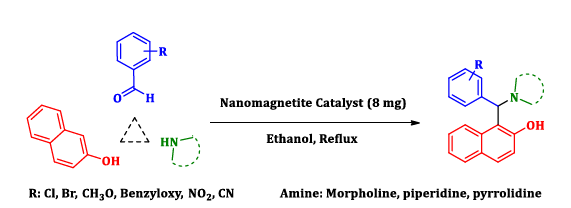
Abstract Magnesium Schiff base complex supported on magnetite nanoparticles (Fe3O4@SiO2 C3H6 magnesium Schiff base complex) was designed and fully identified using different analyses including Fourier transform infrared spectroscopy (FT-IR), energy-dispersive x-ray spectroscopy (EDS), vibrating sample magnetometry (VSM), and scanning electron microscopy (SEM). The presented supported nano-magnetite catalyst was tested as a novel and recyclable catalyst for the preparation of some 1-(α-aminoalkyl)-2-naphthols via the condensation reaction of 2-naphthol with various aromatic aldehydes and some amine compounds including piperidine, pyrrolidine and morpholine with acceptable results. Simple work-up procedures, mild reaction condition, and the recyclability of Fe3O4@SiO2 C3H6 magnesium Schiff base complex are the other advantages of this work.
HPLC Analysis of Phenolic Compounds in Agaricus Bisporus and Pleurotus Ostreatus Mushrooms: An Assessment of Their Antibacterial Capacities

Pages 343-355

https://doi.org/10.48309/chemm.2025.500231.1883

Amin Nameni, Soheila Arghavani, Pouya Ghamari Kargar, Hamid Beyzaei, Milad Ghani, Behrooz Maleki

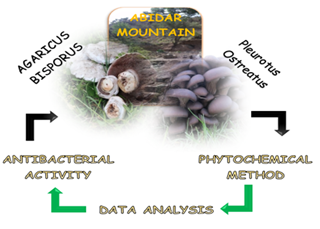
Abstract Two wild edible mushroom species (Agaricus bisporus and Pleurotus ostreatus), collected in the Abidar mountainous area of Sunanda City (Kurdistan Province in the northwestern Iran), were studied in the present work. The methanolic extracts of both mushrooms were prepared by maceration process and screened for pharmacological and therapeutic importance through phytochemical studies. Qualitative and quantitative analyses were performed by the high-performance liquid chromatography technique with ultraviolet detector (HPLC-UV) method to identify phenolic and flavonoid compounds present in the mushrooms. Apigenin, chlorogenic acid, caffeic acid, coumaric acid, quercetin, and kaempferol were among the identified components. The highest amount of phenolic and flavonoid compounds was in the A. bisporus species. In addition, the inhibitory properties of methanolic, ethyl acetate, and aqueous extracts of each mushroom were assessed against three bacterial strains (Staphylococcus aureus: Gram-positive, Escherichia coli: Gram-negative, and Pseudomonas aeruginosa: Gram-negative) using the agar well diffusion method. The antibacterial effects were observed with all extracts against three pathogenic strains, the inhibition zone diameters were recorded in the range of 14.32-23.62 mm. These edible mushrooms as valuable sources of bioactive compounds can enhance the body's immune system and reduce the duration of antibiotic therapy in bacterial infections.

Sustainable Extraction and Purification of Phytochemicals: A Review of Green Solvents and Techniques

Pages 356-385

https://doi.org/10.48309/chemm.2025.504050.1892

Ronald Darwin, Rajachandrasekhar Valmon, Sivanna Chithanna, Sri Hari Galla, Sabeena Hussain Syed, Abdul Ajeed Mohathasim Billah, Konatham Teja Kumar Reddy, Uppuluri Varuna Naga Venkata Arjun

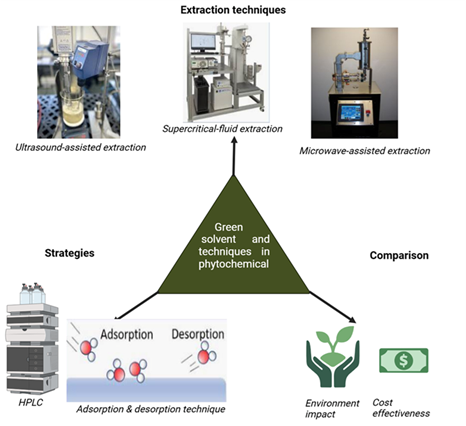
Abstract The importance of phytochemicals in medicine, nutraceuticals, and cosmetics has recently drawn considerable attention toward their sustainable extraction and purification. This review presents the progress in green solvents and methodologies underlined by the drawbacks associated with conventional methods. Phytochemicals are bioactive substances derived from plants that are important for medicinal and commercial purposes. However, most classical methods of extraction and purification involve hazardous solvents and energy-intensive operations, raising environmental and safety concerns. Green solvents, including ionic liquids, deep eutectic solvents, and bio-based solvents, offer environmentally friendly alternatives with high efficiency and low toxicity. These include Supercritical fluid extraction (SFE), Ultrasound-Assisted Extraction (UAE), Microwave-Assisted Extraction (MAE), Pressurized liquid extraction (PLE), and Enzyme-Assisted Extraction (EAE), all of which are advanced green extraction methodologies. These methods afford higher extraction yields while simultaneously reducing the energy consumption and waste generation. Sophisticated purification strategies, including chromatographic techniques, membrane-based purification, and adsorption-desorption procedures, were evaluated for their compatibility with eco-friendly extraction processes. A comparison of the various techniques shows their efficacy, cost, and environmental friendliness. The discussion covers future perspectives, which pinpoint that the development of green solvent formulations, integration of extraction and purification systems, and overcoming of regulatory and scalability challenges are highly needed. This study will be able presents a comprehensive review of sustainable methodologies for the extraction and purification of phytochemicals, which would further help in devising greener, safer, and more efficient approaches in natural product research.

NiZnFe2O3 Quaternary Alloy Nanoparticles to Evaluate Antibacterial Activity against Imipenem-Resistant Bacteria

Pages 386-402

https://doi.org/10.48309/chemm.2025.505451.1896

Mariem Yengui, Asaad T. Al-Douri, Rahma Ttrabelsi, Y. Al-Douri, Radhouane Gdoura

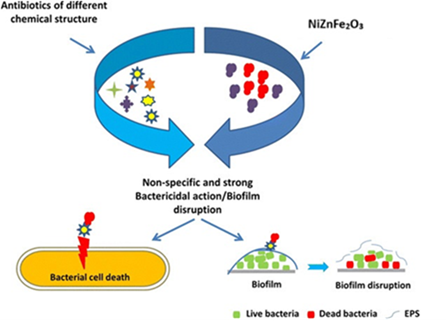
Abstract Carbapenem-resistant Escherichia coli (E. coli) and Klebsiella pneumoniae (K. pneumoniae) infections pose a significant threat to public health due to limited treatment options. Nanoparticles (NPs), particularly those with unique antibacterial properties, have garnered attention as potential alternatives to conventional antibiotics. In the present study, NiZnFe₂O₃ quaternary alloy NPs were synthesized via chemical co-precipitation and evaluated for their antibacterial activity against carbapenem-resistant isolates of E. coli and K. pneumoniae derived from urine samples. Using the agar diffusion method, the NPs exhibited promising antibacterial effects, with inhibition zones ranging from 17 to 21 mm. The minimum inhibitory concentration (MIC) values were determined to be 0.94 µg/mL for K. pneumoniae and 0.46 µg/mL for E. coli, while the corresponding minimum bactericidal concentration (MBC) values were 1.875 µg/mL and 3.75 µg/mL, respectively. These results indicate a bactericidal mode of action, as evidenced by an MBC/MIC ratio of 4. Collectively, these findings demonstrate the potential of NiZnFe₂O₃ NPs as effective agents against carbapenem-resistant pathogens commonly associated with urinary tract infections