7.4 (Q1)
CiteScore2024
Q2
Web of Science
Volume & Issue: Volume 9, Issue 9, September 2025, Pages 737-850 
Number of Articles: 7

Investigation of the Synergetic Effects of GO and Zn on the Electrochemical Properties of Li[Li0.20Mn0.54Ni0.13Co0.13]O2 Cathode Material

Pages 737-750

https://doi.org/10.48309/chemm.2025.509286.1912

Baha Rabah Ahmed, Ali Reyhani, Mohammad Reza Khanlary, Seyedeh Zahra Mortazavi

Abstract This study explores the impact of incorporating graphene oxide (GO) and zinc (Zn) on the electrochemical performance of the Li[Li0.20Mn0.54Ni0.13Co0.13]O2 cathode material, a candidate for high-performance lithium-ion batteries. Through the sol-gel and hydrothermal synthesis methods, composite structures were achieved by combining the base material with GO and introducing Zn as a dopant. Comprehensive electrochemical assessments, including cyclic voltammetry and electrochemical impedance spectroscopy, were conducted to analyze how these modifications affect charge transfer, capacity, and ionic conductivity. The results revealed that the GO addition enhances conductivity and stability, while Zn doping significantly reduces polarization and improves lithium-ion transport. Together, GO and Zn achieve synergistic effects, resulting in improved cycling stability and higher capacity, underscoring their potential to optimize the performance of Li-rich layered oxide cathodes.
Polyphenolic Metabolites of Scutellaria Lateriflora Hairy Root Culture

Pages 751-757

https://doi.org/10.48309/chemm.2025.517133.1947

Yu. N. Elkin, A. Yu. Manyakhin, A. Yu. Stepanova

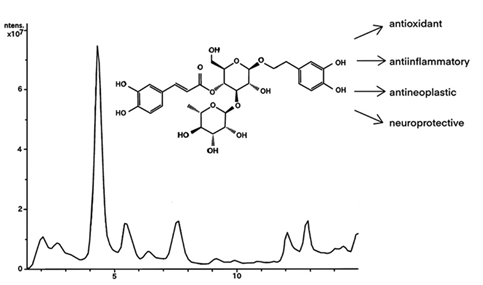
Abstract Scutellaria lateriflora, commonly known as American skullcap, has a long history of use in Western traditional herbal medicine for treating insomnia, anxiety, hysteria, and nervous tension. However, the complete metabolite profile of S. lateriflora extracts has not been fully characterized due to the complexity of metabolite identification. Liquid chromatography-mass spectrometry (HPLC-MS/MS) provides an effective approach for the non-targeted analysis of polyphenolic compounds in plant extracts. The aim of this study was to characterize the polyphenolic profile of hairy root cultures of S. lateriflora using a comprehensive analytical methodology. The metabolome of the hairy root culture was found to be rich in two major classes of bioactive compounds: phenylethanoids (e.g., verbascoside and its derivatives) and flavonoids (e.g., wogonin, 6-OMe-wogonin, and their glucuronides). While the hairy roots produced a similar set of metabolites to those of intact plant roots, quantitative differences were observed, particularly in the enhanced production of phenylethanoids by the hairy root culture. Notably, wogonin and its derivatives were among the most efficiently synthesized flavones. These findings suggest that hairy root cultures of S. lateriflora can serve as a promising biotechnological platform for the targeted production of valuable polyphenolic compounds with potential pharmacological applications.

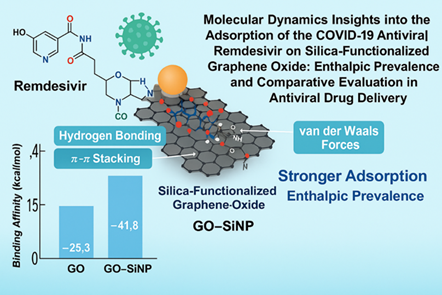
Molecular Dynamics Insights into the Adsorption of the COVID-19 Antiviral Remdesivir on Silica-Functionalized Graphene Oxide: Enthalpic Prevalence and Comparative Evaluation for Targeted Antiviral Delivery

Pages 758-770

https://doi.org/10.48309/chemm.2025.523370.1956

Mohamad T. Raad⸸, Hassan El Said⸸, Abdallah Al Jammal⸸, Josiane Alhage⸸, Ghosoon Albahri⸸, Najwa Baassiry⸸, Hassan HajjHussein⸸

Abstract Remdesivir, a broad-spectrum antiviral agent, has gained widespread attention for treating SARS-CoV-2; however, its therapeutic efficacy remains limited by poor solubility, rapid metabolism, and inefficient delivery. In this study, we employed all-atom molecular dynamics simulations to investigate the adsorption behavior of Remdesivir on a silica-functionalized graphene oxide (GO–SiNP) nanocarrier. The GO–SiNP hybrid integrates the π-conjugated structure and high surface area of graphene oxide with the surface reactivity and aqueous dispersibility of silica nanoparticles, enabling robust non-covalent interactions through hydrogen bonding, π–π stacking, and van der Waals forces. Radial distribution functions indicated a higher molecular affinity in the GO–SiNP system, with a closer peak proximity (~0.28 nm), while RMSD and RMSF analyses showed enhanced conformational stability of the drug at the hybrid interface. Key descriptors of drug–carrier interactions—including RDFs, structural fluctuation, and MM-PBSA binding energies—demonstrated increased interaction persistence and enthalpic prevalence in the GO–SiNP system. The selection of an appropriate partial charge model was found to critically affect the electrostatic interactions and overall binding behavior of Remdesivir with the GO–SiNP nanocarrier. A comparative evaluation with other nanocarriers revealed that GO–SiNP exhibited the most favorable binding affinity (−41.8 ± 1.6 kcal/mol), highlighting its superior potential for antiviral drug delivery. These findings emphasize the importance of tailored surface functionalization in optimizing drug–carrier interactions and support the GO–SiNP hybrid as a promising platform for stable, high-affinity antiviral delivery systems.

Synthesis, Characterization, and Adsorption Studies of Functionalized Graphene Oxide via Covalent Interactions

Pages 771-789

https://doi.org/10.48309/chemm.2025.512176.1916

Meysam Nouri Mollalar, Alireza Banaei, Abdolhossein Massoudi

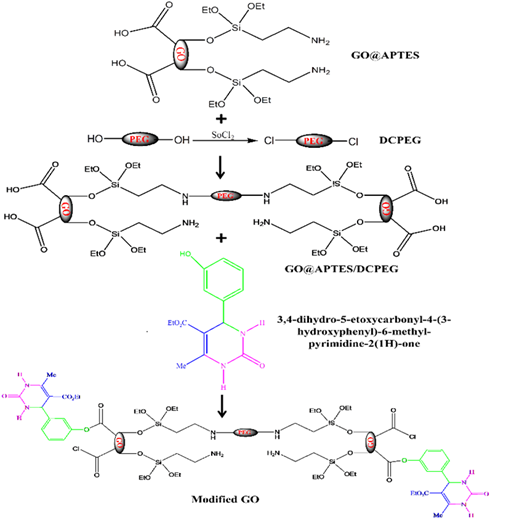
Abstract In this study, graphene oxide (GO) was functionalized with several organic compounds, including 3-aminopropyltriethoxysilane (APTES), dichloro-substituted PEG600 (DCPEG), and 3,4-dihydro-5-ethoxycarbonyl-4-(3-hydroxyphenyl)-6-methyl-pyrimidine-2(1H)-one. The modified GO was then analyzed using various characterization techniques such as Fourier transform infrared spectroscopy (FTIR), scanning electron microscopy (SEM), thermogravimetric analysis (TGA), UV-Visible spectrophotometry (UV-Vis), and X-ray diffraction (XRD). Notably, the modified GO demonstrated excellent performance in adsorbing Reactive Red 239 (RR239) dye from water. The highest removal efficiency of 99.25% was achieved at a pH of 2, a contact time of 90 minutes, an adsorbent dosage of 2 mg, and an initial dye concentration of 20 g L⁻¹. Furthermore, the adsorption isotherm was evaluated using the Langmuir and Freundlich models. The results indicated that the Langmuir model best described the adsorption behavior of RR239, suggesting monolayer adsorption on the surface of the modified GO.

Multifaceted Computational Approach to Explore Nardostachys Jatamansi Neuroprotective Phytochemicals as Potential MAO-B Inhibitors for Parkinson’s Disease

Pages 790-808

https://doi.org/10.48309/chemm.2025.516551.1930

Trupti Pratik Durgawale, Wurood A Shihab, Mohd Masih Uzzaman Khan, Hassan A Madkhali, Mohd Nazam Ansari, Susithra Ethiraj, Mirza Shahed Baig, Thukani Sathanantham Shanmugarajan, Kirti Naik

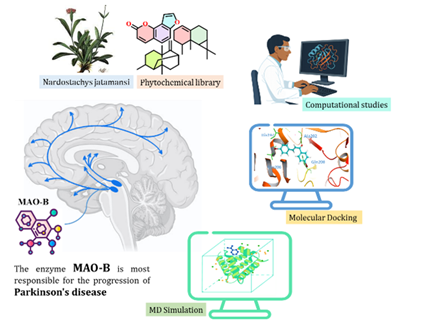
Abstract Parkinson’s disease is a progressive neurodegenerative disorder characterized by the loss of dopaminergic neurons and motor dysfunction, in which MAO-B plays a crucial role by catalyzing the breakdown of dopamine and generating oxidative stress. MAO-B inhibition is a well-established strategy for managing Parkinson’s disease symptoms and slowing disease progression. Given its traditional claims in Ayurvedic medicine for the treatment of neurological disorders, Nardostachys jatamansi was selected for in silico screening to explore its neuroprotective potential. A total of 25 phytochemicals were evaluated using computational tools. All compounds satisfied Lipinski’s Rule of Five and Jorgensen’s Rule of Three, indicating favorable oral bioavailability and drug likeness. Molecular docking studies revealed that the phytochemicals jatamansinone (-9.729 kcal/mol), eselin (-9.138 kcal/mol), and jatamansinol (-8.979 kcal/mol) exhibited strong binding affinities with MAO-B, comparable to the reference inhibitor safinamide (-10.66 kcal/mol). These phytochemicals effectively occupied the active site, interacting with key residues such as Tyr326, and extended into both the entrance and substrate cavities, suggesting a mechanism of inhibition similar to that of safinamide. Furthermore, 100 ns molecular dynamics simulations demonstrated stable interactions and minimal structural changes in the MAO-B-ligand complexes throughout the simulation trajectory. Prediction of Activity Spectra for Substances (PASS) analysis predicted a wide range of neuroprotective properties of these phytochemicals, including antioxidant, anti-inflammatory, neurotransmitter-modulating, and motor-stabilizing activities. Their predicted ability to influence the serotonin and GABA pathways further highlights their potential as promising natural agents for the treatment or prevention of Parkinson’s disease and related neurodegenerative disorders.

Exploring the Dual Antioxidant and Antimicrobial Potential of Cymbopogon Flexuosus Essential Oil: Insights from Molecular Docking and Dynamics Simulations

Pages 809-832

https://doi.org/10.48309/chemm.2025.514976.1924

Ahmed Bayoudh, Nidhal Tarhouni, Amal Ben Hassena, Lamia Khannous, Mohamed Amine Balti, Karim Kriaa, Zakarya Ahmed, Imen Kallel, Bilel Hadrich

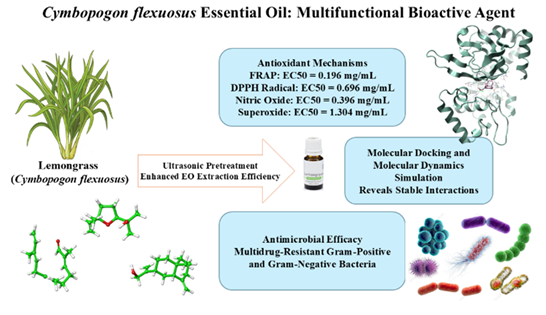
Abstract This study presents a comprehensive investigation of Cymbopogon flexuosus essential oil (LGEO) as a natural antioxidant and antimicrobial agent. LGEO, obtained using ultrasonic pretreatment prior to extraction, exhibited diverse antioxidant activities through multiple mechanisms: strong ferric reducing power (EC50 = 0.196 mg/mL) comparable to vitamin C, DPPH radical scavenging (EC50 = 0.696 mg/mL), effective nitric oxide radical scavenging (EC50 = 0.396 mg/mL) equivalent to vitamin C, and superoxide radical scavenging (EC50 = 1.304 mg/mL). Chemical profiling through GC-MS analysis identified citral (81.92%) as the predominant component, alongside other bioactive compounds. Furthermore, LGEO showed substantial antibacterial efficacy against both Gram-positive and Gram-negative bacteria, with a particular focus on 13 multidrug-resistant Salmonella strains. Through molecular docking and 100 ns molecular dynamics simulations, we elucidated both the antioxidant and antimicrobial mechanisms, revealing stable interactions between LGEO's bioactive compounds (α-sinensal, β-costol, linalool oxide, β-citronellol, nerolidol) and bacterial proteins (PrfA, FtsZ). Structure-activity relationship studies highlighted the significance of specific functional groups in both radical scavenging and antimicrobial activities. These results establish LGEO as a promising natural agent with dual antioxidant and antimicrobial properties, supporting its potential applications in food preservation and pharmaceutical formulations.

Design, Synthesis, and Biological Evaluation of Novel 3-Substituted-5-(3,4-dimethoxy-phenyl)-3H-[1,3,4]oxadiazole-2-Thione Derivatives as Anticancer Agents

Pages 833-850

https://doi.org/10.48309/chemm.2025.517109.1937

Ranjit Vinayak Gadhave, Sanket Bhimrao Shelke, Aniket Biswas, Mayuresh Abhay Shastri, Asawari Deshbandhu Pachauri, Yogita Sachin Ozarde

Abstract This study involved designing and synthesis of 3-substituted-5-(3,4-dimethoxy-phenyl)-3H-[1,3,4]oxadiazole-2-thione derivatives for interaction with EGFR (receptor tyrosine kinase), which plays a role in cancer cell growth. Molecular docking was performed on EGFR receptors using crystal structures with PDB IDs 4WD5 and 2J6M. The combination of hydrogen bonding, hydrophobic, and ionic interactions confirmed the robust nature of the ligand-protein binding. Docking scores for compounds ranged from 6.6 to 8.0 kcal/mol. The compound PODA-21 in this series had the best docking scores of 7.9 and 8.0 kcal/mol, which are greater than the reference drug gefitinib (7.0 and 6.0 kcal/mol) for PDB IDs 4WD5 and 2J6M respectively. The PreADMET study results confirmed good pharmacokinetic and toxicity profile. Ligand interaction with amino acid residues LYS A:745 and MET A:793, shared by reference standard and designed ligands, is vital for the binding affinity and for EGFR inhibition. The synthesized compounds were evaluated (MTT assay and Cell Apoptosis assay) against MCF-7 cell lines, including those resistant to EGFR inhibitors. The MTT assay and cell apoptosis assay showed that samples PODA-21 (“IC50” 50.51±1.64 μg/mL) and AODA-13 (“IC50” 43.00±1.02 μg/mL) exhibited moderate activity when compared to reference standard and molecular docking study came aligned with the biological results. The synthesized compounds displayed optimum biological activity; therefore, these can be treated as lead nuclei for further structural modification.