7.4 (Q1)
CiteScore2024
Q2
Web of Science
Volume & Issue: Volume 9, Issue 11, November 2025, Pages 994-1108 
Number of Articles: 8

Chemical Characterization and Adsorption Kinetics of Methylene Blue: A Comparative Study of Activated Carbon and Plant-Based Bioadsorbents

Pages 994-1015

https://doi.org/10.48309/chemm.2025.529712.1972

Jana Rammal⸸, Mohamad T. Raad⸸, Hassan El Said⸸, Salma Mhanna⸸, Zaher Abdel Baki, Dalia El badan, Mohamad Alameh, Akram Hijazi, Ismail Hijazi

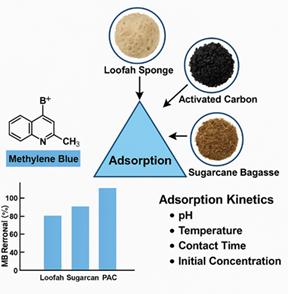
Abstract The search for efficient, low-cost, and sustainable adsorbents is vital to tackling global water pollution. This study compares powdered activated carbon, loofah sponge powder, and sugarcane bagasse powder for removing methylene blue (MB) from water. Physicochemical characterization included pH, moisture and ash content, FTIR spectroscopy, iodine number, particle size, and phenol adsorption to understand the adsorption mechanisms. Batch experiments examined key factors: pH (2.5–11.1), temperature (5–55 °C), contact time (10–150 min), dye concentration (25–400 mg/L), and adsorbent dosage (25–300 mg). Under optimal conditions (20 mg dosage, pH 8, 40 min), PAC showed the highest MB removal efficiency (99.85%), attributed to its high microporosity and oxygenated surface groups. Natural bioadsorbents—loofah and sugarcane powders—also demonstrated strong removal efficiencies (96.64% and 97.53%), highlighting their potential as biodegradable, low-cost alternatives. Compared to literature reports, these bioadsorbents outperform coir pith (76.92 mg/g), pine cone (84.32 mg/g), and zeolite (71.28 mg/g), and greatly exceed activated alumina (55.30 mg/g) in MB adsorption capacity. This demonstrates the superior performance of loofah and sugarcane powders studied here. A strong linear correlation (R² ≥ 0.998) between phenol concentration and UV–Vis absorbance confirmed phenol adsorption as a reliable proxy for adsorption behavior. Adsorption was closely linked to surface functional groups, pore structure, and particle size, supported by FTIR and iodine number data. These results highlight bioadsorbents’ suitability for decentralized or resource-limited water treatment, offering sustainable, affordable solutions. Overall, this study supports integrating eco-friendly, bio-based adsorbents into scalable water purification technologies, advancing sustainable environmental remediation and clean water access.

Novel Imidazo[1,2-α]Pyridine Hybrids: Synthesis, Antioxidant Activity, Cytotoxicity against Cancer Cell Lines, and In Silico Docking Analysis

Pages 1016-1030

https://doi.org/10.48309/chemm.2025.525913.1965

Hussein Ali Al-Bahrani, Heshmatollah Alinezhad, Mahmood Tajbakhsh, Abdul Amir H Kadhum

Abstract This study presents the synthesis of ten novel imidazo[1,2-a]pyridines HB1-HB10 through the hybridization of 4-(imidazo[1,2-a]pyridin-2-yl)benzoic acid with different amines, anilines, and acid hydrazides. The structural characterization of these compounds was accomplished using mass spectrometry (mass), elemental analysis (CHNS), infrared spectroscopy (FTIR), and both 1H-NMR and 13C-NMR spectroscopy. The cytotoxic potential of the hybrids HB1-HB10 was assessed against A549 (lung cancer) and HepG2 (liver carcinoma) cell lines after a 24-hour exposure. Among the synthesized hybrids, compound HB9 exhibited the lowest IC50 value of 50.56 μM against A549 cells, outperforming Cisplatin (IC50 of 53.25 μM). Additionally, HB10 demonstrated significant activity against HepG2 with an IC50 of 51.52 μM, lower than that of Cisplatin (54.81 μM). The antioxidant activity was assessed through the DPPH (2,2-diphenyl-1-picrylhydrazyl) radical scavenging method, which demonstrated a dose-dependent enhancement in activity among the hybrids. Notably, HB7 reached inhibition values of 79%, 81%, and 83% at concentrations of 25, 50, and 100 μg/mL, respectively. Molecular docking simulations with the 3D structure of human LTA4H (3U9W.pdb) indicated that all hybrids interacted with key amino acid residues in the active site, with HB7 exhibiting the strongest binding affinity (S score of -11.237 Kcal/mol) compared to the original ligand (-6.908 Kcal/mol). RMSD analysis revealed that HB1 had the lowest RMSD of 1.049 Å, suggesting a close fit to the original ligand, while several hybrids, particularly HB6 and HB7, engaged with more residues, indicating their potential for diverse interactions.

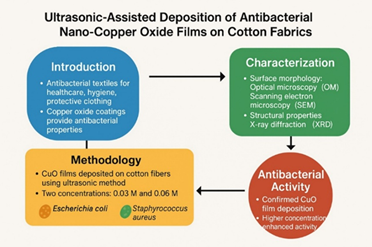
Ultrasonic-Assisted Deposition of Antibacterial Nano-Copper Oxide Films on Cotton Fabrics

Pages 1031-1040

https://doi.org/10.48309/chemm.2025.523341.1957

Muhanna M. Habeeb, Hamidreza Fallah

Abstract The development of antibacterial textiles is essential for applications in healthcare, hygiene, and protective clothing. Among various approaches, Copper oxide nanoparticles (CuO NPs) were successfully deposited onto cotton fibres using an ultrasonic spray-coating technique to enhance their antibacterial functionality. The molarity of the precursor solution was identified as a critical factor influencing the morphology, structural properties, and antibacterial efficacy of the coated cotton fibres. Two molar concentrations (0.03 M and 0.06 M) were used to assess the effect of CuO loading on the coating characteristics and antibacterial performance. The treated fabrics were rigorously evaluated against two bacterial strains: Escherichia coli (Gram-negative) and Staphylococcus aureus (Gram-positive). Comprehensive morphological and structural characterization of the CuO films was conducted using optical microscopy (OM), scanning electron microscopy (SEM), and X-ray diffraction (XRD) to determine surface uniformity, particle distribution, and crystallinity of the deposited thin films. The biological findings revealed that the CuO-coated fabrics exhibited significant antibacterial activity against both bacterial strains with increased effectiveness observed at the higher molarity. These findings indicate that ultrasonic deposition of CuO thin films on cotton fibres provides a promising route for producing antimicrobial textiles with potential applications in medical, hygienic, and protective clothing. Overall, CuO-coated cotton fabrics demonstrated effective bacterial inhibition, highlighting their potential for antimicrobial textile applications. The molarity of the CuO solution significantly influences both coating quality and antibacterial efficacy.

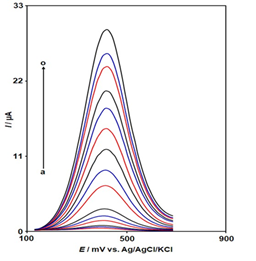
Novel Voltammetric Sensor Based on Ionic Liquid and Co-MOF/MWCNTs Nanostructure: Simple and Sensitive Electrochemical Determination of Daunorubicin

Pages 1041-1053

https://doi.org/10.48309/chemm.2025.523625.1958

Somayeh Tajik, Fatemeh Raeeszadeh, Mohammad Reza Aflatoonian, Sayed Zia Mohammadi, Fariba Garkani Nejad, Hadi Beitollai

Abstract A novel electrochemical sensor based on carbon paste electrode (CPE) modified with ionic liquid (IL) and nanostructure of cobalt-2-amino-1,4-benzenedicarboxylic acid metal-organic framework (Co-BDC-NH2 MOF) and multi-walled carbon nanotubes (MWCNTs) has been designed and applied for voltammetric determination of daunorubicin. The electrochemical analysis of daunorubicin was performed using cyclic voltammetry (CV) studies, chronoamperometry investigations, and differential pulse voltammetry (DPV) measurements. Due to the improved electron transfer rate at the surface of Co-BDC-NH2 MOF/MWCNTs/ILCPE, the redox peak currents of daunorubicin were higher than other CPEs. From DPV measurements, the Co-BDC-NH2 MOF/MWCNTs/ILCPE-based electrochemical sensing platform detected daunorubicin in the range of 0.008 µM to 340.0 µM, with the limit of detection (LOD) for daunorubicin being 0.003 µM. Furthermore, the developed sensing platform was efficiently used for the analysis of daunorubicin injection with recoveries in the range of 97.8% to 104.0% and relative standard deviations (RSDs) less than 3.3%.

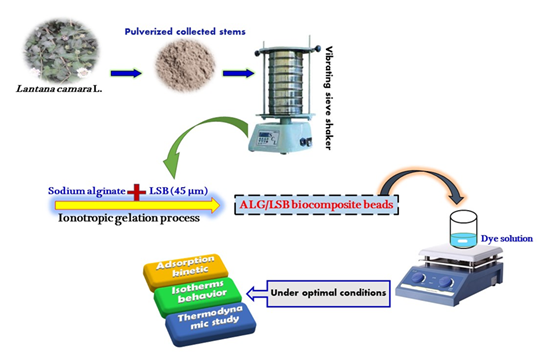
Synthesis of Alginate–Based Biocomposite Containing Biomass Derived from Lantana camara L. Stem as a Novel Biopolymeric Sorbent for Methylene Blue Uptake

Pages 1054-1068

https://doi.org/10.48309/chemm.2025.527953.1969

Mohsen Samimi

Abstract Hydrogels have emerged as promising water and wastewater treatment materials due to their unique properties, such as hydrophilicity, swellability, and modifiability. Herein, alginate hydrogel (ALG) containing biomass derived from Lantana camara L. stem (LSB) was proposed as a novel bio-composite for the adsorptive removal of methylene blue (MB) from aqueous solutions. The optimized condition to achieved the maximum biosorption capacity and removal efficiency of MB using ALG/LSB bio-composite was obtained at the pH value of 9, polymer concentration of 1.25% w/v, a bio-composite dosage of 0.29 g.L-1 (90 mg.L-1 of ALG containing 0.2 g.L-1 of LSB), initial MB concentration of 50 mg.L-1, environmental temperature of 318 K, and at 50 min. The findings were closer to the Langmuir model (R2=0.9997), which characterizes monomolecular adsorption on homogeneous surfaces. The maximum adsorption capacity of the analyte using the synthesized bio-composite was 178.57 mg.g-1. The adsorption rate was acceptably characterized by the pseudo-second-order kinetic model (R2 = 0.99 and qe = 185.15 mg.g-1). The precision of the Intra-particle diffusion mechanism was evident (R2 = 0.978). The thermodynamic analysis (ΔG° = -11.286 kJ.mol-1, ΔH° = +17793.6 J. mol-1, and ΔS° = +91.445 J. mol-1.K-1 at 318 K) indicated that analyte bio-sorption was both an endothermic and spontaneous process. The ALG/LSB bio-composite was introduced as a novel, cost-effective, efficient, and biocompatible bio-polymeric adsorbent for the removal of cationic dye from aqueous environments.

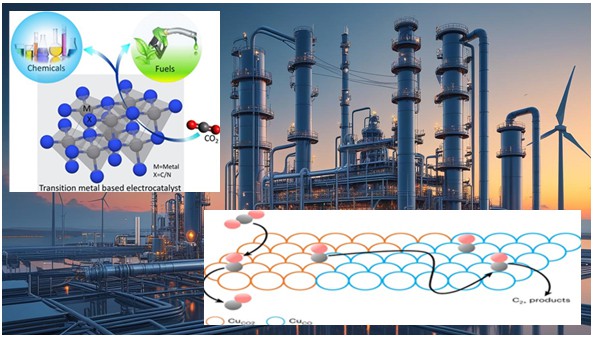
Use of New Technologies for Enhanced CO2 Reduction Reactions in Oil and Gas Refinery

Pages 1069-1081

https://doi.org/10.48309/chemm.2025.520620.1951

Sapaev Bayramdurdi, Norov Begmat Kholmatovich, Dilafruz Makhkamova, Baxtigul Nurullaeva, Kholmurodova Dilafruz Kuvatovna, Shoyusupov Shokirjon Azizovich, Akabirova Diloro Nigmatovna, Dilbar Urazbaeva, Husssam Elddin Nabieh Khasaewnerh

Abstract Carbon dioxide (CO2) capture is a key technology in the fight against climate change. With growing concerns about the effects of greenhouse gases, carbon capture and storage (CCS) methods have been touted as an effective solution to reduce CO2 emissions. The Verdux system is an electrically powered device that helps capture and remove carbon. Developed by an MIT team led by Sahag Vescian and T. Alan Hutton, the system uses electrochemistry to capture carbon almost effortlessly. At the heart of the method is a technology which the researchers describe as impressive and efficient. Most efforts to capture carbon from exhaust streams or the air itself require a lot of energy, but Vescian and Hutton have come up with a design that uses electrochemistry to capture carbon. Their invention is a kind of battery: conductive electrodes are coated with a compound called polyanthraquinone, a natural chemical adsorbent for carbon dioxide under certain conditions. When these special conditions are not present, polyanthraquinone has no desire to absorb carbon dioxide. When activated by a low-level electrical current, the charged battery reacts with passing carbon dioxide molecules, drawing them to its surface. When the battery is saturated, the carbon dioxide can be released as a stream of pure gas with a small voltage change. Verdex's technology should be able to capture carbon dioxide from the air and its sources of emissions at the mega- and gigatonne level.

Enhancing OER Performance with Electrodeposited NiPSe Nanostructures: Synergistic Effects and Kinetic Insights

Pages 1082-1093

https://doi.org/10.48309/chemm.2025.520162.1960

Milad Nikandish, Vahid Shamshiri

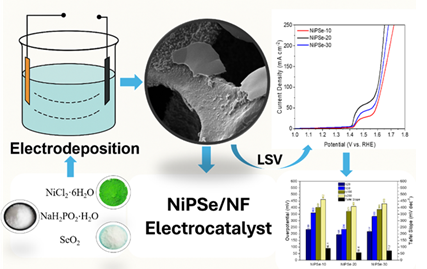
Abstract The rational design of high-performance, economical electrocatalysts for the oxygen evolution reaction (OER) represents a crucial step toward sustainable energy solutions. In this study, a simple electrodeposition technique is employed to fabricate nickel-phosphorus-selenium (NiPSe) nanostructured catalysts designed to enhance OER performance. The optimized NiPSe electrocatalyst displays remarkable catalytic performance, attaining a substantially reduced overpotential of merely 371 mV to drive a current density of 100 mA cm-2, coupled with rapid reaction kinetics evidenced by its low Tafel slope of 58.4 mV dec-1. These superior electrochemical characteristics highlight the material's efficient charge transfer properties and catalytic effectiveness. Electrochemical impedance spectroscopy (EIS) and electrochemically active surface area (ECSA) assessments further confirm the decrease in charge-transfer resistance and an increased density of active sites, both contributing to superior catalytic behavior. Moreover, the NiPSe electrode demonstrates excellent durability, retaining its performance over a 24-hour continuous operation with minimal degradation. This enhanced performance stems from the cooperative effects between nickel and phosphorus components, combined with the electronic conductivity benefits provided by selenium incorporation. These results highlight a promising and scalable route for engineering robust, earth-abundant electrocatalysts for industrial-scale water splitting technologies.

Identify a New Anti-Alzhimer Candidate Based on Compounds Derived from Fatty Acids by High-Throughput Screening Approach

Pages 1094-1108

https://doi.org/10.48309/chemm.2025.527034.1968

Sobhan Ghazimoradi, Seyyed Mohammad Mahdi Mousavi Bidak, Masoumeh Fallah Ziarani, Sorour Ramezanpour

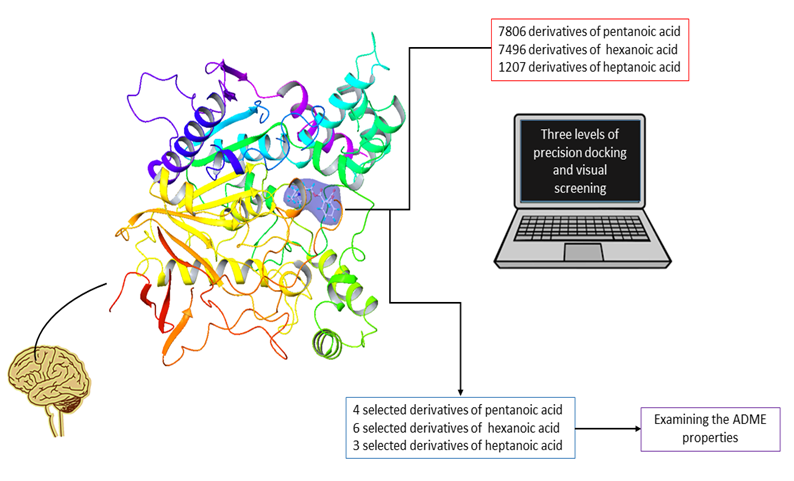
Abstract Alzheimer's disease (AD), which is associated with progressive memory impairment and forgetfulness, causes numerous problems not only for the patient, but also for those close to the patient. According to statistics from the World Health Organization (WHO), approximately 55 million people in the world are currently infected with this disease, and 10 million people are infected with this disease every year. Unfortunately, despite extensive research, no cure exists for this disease so far. But fortunately, every year, extensive scientific research is conducted around the world to treat this disease or decline its progression. Recent research has attempted to identify new inhibitors of the acetylcholinesterase (AChE) enzyme, one of the main enzymes effective in this disease. In this research, a high-throughput virtual screening (HTVS) procedure was used on fatty acid derivatives based on the 5, 6, and 7 carbon main chain. The result of this research was the identification of four compounds based on pentanoic acid, six compounds based on hexanoic acid, and three compounds based on heptanoic acid. Additionally, for these compounds, ADME (Absorption, Distribution, Metabolism, and Excretion) properties were obtained.