7.4 (Q1)
CiteScore2024
Q2
Web of Science
Volume & Issue: Volume 3, Issue 6, November and December 2019, Pages 620-731 
Number of Articles: 10

Green Synthesis of Benzimidazole Derivatives: an Overview on Green Chemistry and Its Applications

Pages 620-631

https://doi.org/10.33945/SAMI/CHEMM.2019.6.1

Mohammad Asif

Abstract The chemical substances in our environment are rising day by day. Only some of them are degraded, but most of them are non-degradable. These non-degradable substances produce pollutions which cause instability, harm or discomfort to the ecosystem as pollutions and create a risk to the environment. To reduce the possibility of a system we must reduce the risk not by altering the effect but by the cause. Thus, green chemistry (GC) concept was introduced, and it is a rapidly emerging field of chemistry. The GC is the design of chemical products and procedures that decrease or remove the use and production of harmful substances. In recent years, various heterocyclic compounds have appeared owing to the extensive varieties of their pharmacological activities. Benzimidazole is a heterocyclic aromatic compound. It is a vital and advantaged structure in medicinal chemistry and plays a role with ample therapeutic activities like analgesic, anti-inflammatory, antiulcer, antihypertensive, antibacterial, antiviral, antifungal, anticancer and antihistaminic. Because of its value, the processes for their synthesis have become a focus of synthetic chemists. Therefore, this review aims at compiling the chemistry of differently substituted benzimidazoles and some other methods. Conventional methods of synthesis need longer heating time, complicated and tedious apparatus set up which result in high cost and pollution in contrast to greener methods which are inexpensive. 

Green Synthesis of ZnO Nanoparticles via Sol-gel Method and Investigation of Its Application in Solvent-free Synthesis of 12-Aryl-tetrahydrobenzo[α]xanthene-11-one Derivatives Under Microwave Irradiation

Pages 632-642

https://doi.org/10.33945/SAMI/CHEMM.2019.6.2

Saeid Taghavi Fardood, Ali Ramazani, Farzaneh Moradnia, Zolfa Afshari, Sara Ganjkhanlu, Fateme Yekke Zare

Abstract In this work, zinc oxide (ZnO) nanoparticles were fabricated using Arabic gum as a reducing and stabilizing agent by the novel sol-gel method without adding any surfactants. The synthesized nanoparticles were characterized by Fourier transform infrared spectroscopy (FTIR), powder X-ray diffraction (XRD), and scanning electron microscopy (SEM). Subsequently, ZnO nanoparticles as efficient catalysts were consumed for the three-component coupling of 2-naphthol, aldehydes, and dimedone under microwave irradiation and solvent-free conditions in order to furnish the corresponding synthesis of 12-aryl-tetrahydrobenzo[α]xanthene-11-one derivatives in high yields.

Vanadium(IV) Schiff base Complex: Synthesis, Characterization, Crystal Structure and Thermal Decomposition into V2O5 Particles

Pages 643-650

https://doi.org/10.33945/SAMI/CHEMM.2019.6.3

Aliakbar Dehno Khalaji, Maryam Ghorbani, Seyyed Javad Peyghoun, Norollah Feizi, Alireza Akbari, Wolfgang Hornfeck, Michal Dusek, Vaclav Eigner

Abstract Vanadium(IV) complex [VO((MeO-bph)2en)] (1), (MeO-bph)2en=N,N¢-bis(2-hydroxy-4-methoxybenzophenone)-1,2-ethanediamine, was synthesized and characterized by elemental analyses (CHN), FT-IR spectroscopy, thermogravimetry, SEM and single crystal X-ray diffraction. The title complex 1 was prepared by the reaction of VO(acac)2, 1,2-ethanediamine and 2-hydroxy-4-methoxybenzophenone (molar ratio 1:1:2). The single-crystal X-ray analysis of 1 shows that the vanadium(IV) ion is located in a distorted square pyramid (N2O3) environment with the tetradentate Schiff base ligand coordinated in equatorial positions and one oxygen atom in the axial position. Thermogravimetric analysis shows that the complex 1 decomposes in two stages. Finally, the complex was calcinated at 500 °C for 3 h and the V2O5 products characterized by FT-IR and SEM.

Synthesis and Characterization of Aluminium Sulphide (Al2S3) Thin Films

Pages 651-662

https://doi.org/10.33945/SAMI/CHEMM.2019.6.4

I. Lucky Ikhioya, B.O. Ijabor, G.M. Whyte, F.I. Ezema

Abstract The synthesis of Al2S3 thin film was carryout using electrodeposition technique. The electrodeposition bath system is composed of a source of cation (i.e. AlSO4.17H2O for Al2+) and a source of anion (i.e.  Na2SO4 for S2-).  Indium doped Tin Oxide (ITO)  was  used  as  the  cathode  while  the  anode  was  carbon and fluorine electrode. The temperature was varied by heating the entire precursor using a standard heating mantle with temperature ranges from 20 °C- 120 °C and the growth of Al2S3 thin films was carried out using the temperature range from 50 °C-80 °C at interval of 10 °C which later was converted to Kelvin. The XRD was found to be of wurtzite-like structure as hexagonal crystal structure that corresponds to 100, 110 and 111 plane. All the samples deposited at different temperature are crystalline in nature with lattice constant, (). Scanning electron microscopy (SEM) was carried out to reveal the micro-structural properties of aluminium sulphide thin films material. It was observed that as the wavelength of the incident radiation increases the absorbance of the material decreases. The sample deposited at 353 K recorded the highest absorbance at 380 nm. The sample deposited at 333 K recorded the highest transmittance at 1180 nm. Al2S3 film has a low transmittance less than 30% in the visible wavelength 520–720 nm and less than 60% transmittance in the near infrared wavelength 760–1200 nm which showed that as the wavelength of the incident radiation increases the transmittance of the films increases. The resistivity of the material decreases as the temperature and thickness of the materials increases while the conductivity of the material increases as the temperature and thickness of the material increases. The band gap energy of Al2S3 thin films deposited at (323 K-353 K) as obtained from the plot is given as 2.4-3.0 eV.

Lithium–functionalization of Pyrrole–n–carboxylic Acids (n=1, 2, 3)

Pages 663-672

https://doi.org/10.33945/SAMI/CHEMM.2019.6.5

Nahid Ghasemi, Mahmoud Mirzaei

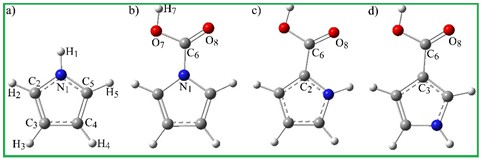
Abstract Functionalization processes of neutral and ionic forms of the singular lithium element (Li/Li+) by the pyrrole–n–carboxylic acid (PnCA; n=1, 2, 3) have been investigated based on the quantum chemical density functional theory (DFT) calculations. To this aim, molecular and atomic scales parameters have been obtained for the optimized structures of original and Li/Li+ functionalized complex models of PnCA. The results have indicated that the structural shapes and the O8 dominant atom properties are similar to P1CA and P3CA models but different from P2CA model. Moreover, the adsorption energies have indicated that the P3CA model could be considered as the best choice for both of Li and Li+ functionalization processes. The orbital distribution patterns and dipole moments have also approved the Li/Li+ functionalization by the PnCA species. As a result, the PnCA species could be suggested as suitable adsorbents of neutral and ionic forms of the Li element.

Evaluation of Ground and Excited State Dipole Moments of 2(3)-tetra(tert-butylphenoxy)phthalocyaninato Zinc(II) from Solvatochromic Data

Pages 673-687

https://doi.org/10.33945/SAMI/CHEMM.2019.6.6

Abimbola Ogunsipe, Patrick Bokolo

Abstract This article presents a semi-empirical determination of ground state dipole moment (mg) and excited state dipole moment (me) of 2(3)-tetra(tert-butylphenoxy)phthalocyaninato zinc(II) (ZnTBPc) using the solvatochromic shift method, which is based on the Onsager’s reaction field theory. A combined application of the Bakshiev’s equation and the Kawski-Chamma-Viallet’s equation was used to determine the ratio me/mg while the use of the molecular-microscopic solvent polarity parameter yielded the term Dm (me- mg). The dipole moment of ZnTBPc in its excited singlet state (me=4.46D) is more than twice as much as that in its ground state (mg=2.14D).These values suggest that the higher charge separation is greater in the excited state of ZnTBPc than in its ground state.

Theoretical Study of First Singlet Excited State of Para-Substituted Platinabenzene Complexes

Pages 688-703

https://doi.org/10.33945/SAMI/CHEMM.2019.6.7

Gholamreza Ghane Shalmani, Reza Ghiasi, Azam Marjani

Abstract The structure, electronic properties, and aromaticity of the para-substituted platinabenzenes were illustrated by applying the hybrid density functional MPW1PW91 theory. The electron donor groups (EDG) and electron withdraw groups (EWG) effects on geometry, frontier orbital energies, reactivity indices and aromaticity in the first singlet excited state of platinabenzene were investigated and compared to ground state. The contribution of the fragments of the studied complexes in the frontier orbitals were calculated both in terms of the ground state and the first singlet excited state. Linear correlations between the studied parameters with Hammett's constants (sp) were given in the two studied states.

Metal-Organic Framework MIL-53(Fe) as a highly efficient reusable catalyst for the synthesis of 2-aryl-1H-benzimidazole

Pages 704-712

https://doi.org/10.33945/SAMI/CHEMM.2019.6.8

Azadeh Nozarie

Abstract Metal-organic framework MIL-53(Fe) (MIL = Materials of Institute Lavoisier) as recyclable and heterogeneous catalyst efficiently catalyzed the synthesis of 2-Aryl-1H-Benzimidazole derivatives from o-phenylenediamine and aldehydes in solvent-free condition. This method provides benzimidazole in good to excellent yields with little catalyst loading. Furthermore, the catalyst can be readily isolated by filtering and no obvious loss of activity was observed when the catalyst was reused in five consecutive runs.

Studies on Isora Fibers Mixed with 1% Ricinoleic Acid Reinforced with Polypropylene

Pages 713-720

https://doi.org/10.33945/SAMI/CHEMM.2019.6.9

A.U Santhoskumar, N. Jaya Chitra

Abstract The aim of this study is to investigate the effectiveness of Isora fiber mixed with 1% ricinoleic acid as a reinforcement for polypropylene (PP) thermoplastic matrix. Isora fibers were subjected to mercerization prior to blending with PP in order to obtain good interfacial adhesion with the matrix. A PP/Isora composite has been prepared by melt blending of PP with 5%, 10%, 15%, 20% alkali treated Isora fiber in co-rotating twin screw extruder. The extruded strands are pelletized and then injection-moulded to obtain specimens. The optimum compositions of the PP/alkali treated Isora composites were mixed with 1% ricinoleic acid. Fiber-matrix adhesion will be analysed by mechanical and thermal properties of the composites which were evaluated.

Effects of Freeze-drying and Freezing on Vitamins and Sugars of Mango Pulp (‘Apple’ Cultivar): A Preliminary Comparison of Methods for Improving Sample Storage

Pages 721-731

https://doi.org/10.33945/SAMI/CHEMM.2019.6.10

Kennedy Olale, Walyambillah Waudo, Salim Ali Mohammed

Abstract Mango (Mangifera indica L.) fruits are highly perishable ones whose important nutrients such as vitamins and sugars quickly decrease under storage. In this study, we compared two methods of fruit pulp storage; freezing and freeze-drying in order to compare total carotenoids, β-carotene, ascorbic acid (AA), titratable acidity (TTA), total soluble solid (TSS) and pH. Mean total carotenoid, β-carotene and AA of frozen pulp were 7.08±0.15 µg/g, 1.47±0.09 µg/g and 92.77±17.49 mg/100 g respectively. While freeze-dried pulp had 8.06±0.03 µg/g, 2.35±0.03 µg/g and 113.02±0.07 mg/100 g for total carotenoid, β-carotene and AA respectively. The total carotenoid, β-carotene and AA of fresh pulp were; 8.15 µg/g, 2.44 µg/g and 119 mg/100 g respectively. TTA, TSS and pH were; 3.01±1.01%, 9.40±1.42 °Brix and 2.97±0.19 for frozen pulp and 2.97±0.01%, 11.70±0.08 °Brix and 2.99±0.01 for freeze dried pulp respectively. TTA, TSS and pH for fresh pulp were; 4.85%, 11.90 Brix% and 3.48 respectively. All measured parameters were significantly higher (p <0.05) in fresh sample than in the stored pulp (frozen or freeze-dried). Mean total carotenoids, β carotene, AA and TSS were significantly (p <0.05) higher for freeze-dried pulp than for frozen pulp. However, mean TTA and pH did not differ between freeze-dried and frozen pulp. Slow decrease of AA in the freeze-dried pulp further suggests the method as preferred for long term storage of mango pulps.