7.4 (Q1)
CiteScore2024
Q2
Web of Science
Volume & Issue: Volume 5, Issue 6, November and December 2021, Pages 454-564 
Number of Articles: 9

Chemical Composition and Insecticidal Activities of Mentha Longifolia and Mentha Mozaffarianii Essential Oils against Callosobruchus Maculatus

Pages 454-463

https://doi.org/10.22034/chemm.2021.136811

Ali Mirshekar

Abstract Essential oils from two species of Mentha genus, (Mentha longifolia L. and Mentha mozaffarianii Jamzad), from the mint family Lamiaceae that grow in Iran were isolated and analyzed by GC and GC-MS and their insecticidal and repellent activities were investigated against adult cowpea beetles. Mortality rates increased with increasing of the time of exposure and concentration, where M. mozaffarianii oil showed more potent toxicity. Using the topical application, LD50s values of M. mozaffarianii and M. longifolia oils at 96 h after exposure against adults were 22.7 and 39.4 μg/adult, respectively. In the fumigant test, LC50s at 96 h after exposure was between 38.5 and 55.4 µL/L air against adults, respectively. The results demonstrated that no concentration-dependent effect was observed in the test of the repellent effect and M. longifolia oil was most repellent to C. maculatus adults at 10 µl/l air (29.00%) while M. mozaffarianii oil’s repellency was 9% at a lower concentration of 5 µl/l air. The main chemical components of the M. longifolia oil were Pulegone (48.67%), Menthone (14.31%), 1, 8- Cineole (9.37%) and Camphor (6.60%) while the major constituents of oil of the M. mozaffarianii were Piperitone (23.59%), Linalool (14.44%), 1, 8- Cineole (11.77%) and Piperitenone oxide (9.39%).

Design, Synthesis and Antimicrobial Activity Evaluation of New Bisimidyl Sulfonamido Ketone Comprising Drug component

Pages 464-470

https://doi.org/10.22034/chemm.2021.137365

Zaynab Hussein Fadel, Ahlam Marouf Al-Azzawi

Abstract This work involved design and synthesis of four new compounds which their molecules contain three biologically active segments, including β-lactam containing drug, cyclic imide and sulfonamido group. Synthesis of the compounds was performed by several steps. In the first step, compound (1) bis[N-phenyl phthalamic acid] ketone was synthesized via reaction of aniline with benzophenone 3,3’,4,4’-tetra carboxylic dianhydride. In the second step, compound (1) was dehydrated by fusion to give the corresponding bis phthalimide (2) which in turn was introduced in reaction with chloro sulfonic acid. The third step involved producing compound (3), the corresponding bis phthalimidyl benzene sulfonyl chloride. Compound (3) is the important key compound from which the target compounds (4-7) were prepared through its reaction with different β-lactam containing drugs. Antibacterial and antifungal activities of compounds (4-7) were screened and the results indicated that they have high biological activity.

Validation of a Rapid and Sensitive Reversed-Phase Liquid Chromatography Method and Force Degradation Study of Synthesized (E)-3-(2,4,6-tri-Methoxyphenyl)-1-phenylpro-2 ene-1-one

Pages 471-484

https://doi.org/10.22034/chemm.2021.138070

Uttam Shinde, Sanhita Patil, Rupali Thorave, Dipalee Malkhede

Abstract A stability-indicating RP-HPLC method was developed and validated for the determination of  the estimation of newly synthesized (E)-3-(2,4,6-tri-methoxyphenyl)-1-phenylpro-2 ene-1-one in API form by using C18 column Phenomenix (250 mm x4.6 mm,5µm), with a mobile phase consisting of a acetonitrile and  methanol (40:60 v/v) with flow rate of 0.7 mL/min. The detection was carried out at 370 nm and retention time (Rt) of (E)-3-(2, 4, 6- tri-methoxyphenyl)-1-phenylpro-2 ene-1-one was found to be 2.55 min. Linearity was observed from the concentration range of 10-50µg/mL (n=5), (coefficient of determination R2 was 0.997) with the equation of y= 0.495x + 0.111. The method was repeatable with a relative standard deviation (RSD) of 0.16 to 1.98 %. The newly developed method was validated according to the ICH guidelines with respect to specificity, linearity, accuracy, precision and robustness. (E)-3-(2,4,6-tri-methoxyphenyl)-1-phenylpro-2 ene-1-one was subjected to different stress conditions as per ICH guidelines like acidic alkaline, oxidative, thermal and the results showed that it was more sensitive towards oxidative.

Investigation of Closed Formula and Topological Properties of Remdesivir (C27H35N6O8P)

Pages 485-497

https://doi.org/10.22034/chemm.2021.138611

Sabir Hussain, Ammar Alsinai, Deeba Afzal, Ayesha Maqbool, Farkhanda Afzal, Murat Cancan

Abstract Coronavirus is able to cause illnesses ranging from the common flu to severe respiratory disease. Today there is great competition among researchers and physcisians to cure COVID-19. Remdesivir is being studied for the COVID-19 treatment. In this article, we presented the topological analysis of remdesivir with the help of M-polynomial. Proofs of the closed form of some topological indices via M-polynomial are also included in this article.

A New Continuous Flow Injection Analysis Method Coupled with NAG-ADF-300-2 Analyzer for Promethazine-HCl by Cadmium Iodide as a Precipitating Reagent

Pages 498-512

https://doi.org/10.22034/chemm.2021.138807

Ghadah F. Hussein, Nagham S. Turkey

Abstract A highly accurate, simple, sensitive turbidimetric method was introduced for the determination of promethazine-HCl using a homemade NAG-ADF-300-2 system with continuous flow injection analysis system. This method is based on reaction between promethazine-HCl and cadmium iodide (CdI2) in the presence of ammonium acetate to obtain a white precipitate for the ion-pair complex. Turbidity was measured via the attenuation of incident light by precipitated at 0-180°. Optimum parameters were studied to increase the sensitivity for newly developed methodology of promethazine-HCl- cadmium iodide system. The linear dynamic range for the instrument response vs. concentration of promethazine-HCL- was 0.25-25 mmol. L-1 for cell A and 0.1-20 mmol.L-1  for cell B, and limit of quantitative (S/N=10) 360.5574 µg /sample for cell A and 275.5830  µg /sample for cell B respectively with correlation coefficient (r) 0.9961 for cell no. 1 (cell A) and 0.9966 for cell no.2 (cell  B); RSD % was lower than 0.6%. A comparison was made between the newly developed method with UV-Spectrophotometric and turbidimetric method as a classical method by using the standard addition method via the use of t-test at 95% confidence level. In addition, F-test was utilized to predict which of the methods was more precise than other method. The comparison of data revealed that long distance chasing photometer (NAG-ADF-300-2) is the choice with excellent extended detection, wide application and more sensitivity.  

A Green Approach for Photometric Determination of Copper β-Resorcylate in Double Base Solid Propellants

Pages 513-521

https://doi.org/10.22034/chemm.2021.138827

Ali Reza Zarei, Kimia Mardi

Abstract This paper describes the applicability of micellar media instead of extraction steps with toxic solvents for direct determination of copper beta-resorcylate as burning rate catalyst in double base propellant (DB propellant). The method is based on a simple and safe sample preparation of DB propellant, and then complex formation of copper ion with Diethyldithiocarbamate (DDTC) in the presence of sodium dodecyl sulfate (SDS) as a micellar media. Under optimal conditions, at λmax= 445 nm, the calibration graph was linear in the range of 0.25-4.5 µg mL-1 for copper with detection limits 0.125 µg mL-1. The validity of the method was evaluated by means of the data statistical analysis. For this purpose, the method was applied to the determination of copper beta-resorcylate in DB propellant and the results were statistically compared based on t- and F-tests with those obtained by the by ICP-AES. There was no significant difference between the mean values and the precisions of the two methods at the 95% confidence level. The results showed that the proposed method offers an accuracy and reliable approach for the determination of copper β-resorcylate in DB propellant, and can be suggested as a routine method in military quality control laboratories.

Photodegradation of Tramadol Using α-Fe2O3 nanoparticles/ 12-tungstosilicic Acid as an Efficient Photocatalyst in Water Sample Employing Box-Behnken Design

Pages 522-533

https://doi.org/10.22034/chemm.2021.138835

Farshid Kazemi, Hasan ali Zamani, Mohamad Reza Abedi, Mahmoud Ebrahimi

Abstract In this study, a photocatalyst based on the combination of a polyoxometalate (12-tungstosilicic acid) and a nanoparticle (α-Fe2O3) was prepared to investigate its ability to degrade Tramadol from water samples. The structure, morphology, and functional groups of the synthesized photocatalyst (α-Fe2O3/ 12-tungstosilicic acid) were characterized using SEM images, EDX pattern, TEM image, FAM images, and FTIR spectra. Due to the high surface-to-volume ratio in nanoparticles and high intramolecular charge transfer by polyoxometalates, the combination of α-Fe2O3 nanoparticles and 12-tungstosilicic acid as a photocatalyst exhibits a high photodegradation efficiency in a suitable time toward the tramadol degradation. Besides, several factors affecting the degradation process of Tramadol with the prepared photocatalyst were evaluated using an experimental design method based on Box-Behnken design to reduce the number of experiments and study the interaction between the factors. In optimal conditions, the tramadol concentration, pH of the sample solution, photocatalyst amount, and the hydrogen peroxide concentration were optimized, which were 90.0 mg L-1, 300 mg L-1, 7.6, and 0.6 mg L-1, respectively. The study of the photocatalyst activity and the degradation kinetics for the tramadol photodegradation as a pharmacological contaminant in a water sample under ultraviolet irradiation exhibited that the synthesized photocatalyst had a high photodegradation efficiency with a pseudo-first-order rate constant of 0.0232 min-1 for a photodegradation time of 70 min.  

Reactive Separation of Gallic Acid Using Phosphoric and Aminic Extractants in Non-Toxic Natural Diluents

Pages 534-554

https://doi.org/10.22034/chemm.2021.139021

Nishant Joshi, Amit Keshav, Anil K. Poonia, Jagamohan Meher

Abstract Bio production of gallic acid and its recovery from bioconversion media have captured considerable interest of researchers. Extractive separation with solvents can be utilized for the recovery of gallic acid; however, the issue of toxicity of solvents towards microbes needs to be addressed. Physical extraction with natural solvents is observed to be insufficient as highest distribution coefficient (KD) were observed to be 0.136 for sesame oil, 0.111 for rice bran oil and around 0.041 for sunflower oil. Higher separation efficiencies are desirable for a successful extraction system and in this regard employing a reactive component (extractants) could be intensified solution. Three different extractants (tri-n-butyl phosphate (TBP), tri-octyl amine (TOA) and Aliquat 336) were investigated for their capabilities to improve extraction when present in three non-toxic diluents (sunflower oil, rice bran oil and sesame oil) comprising 9 possible combinations employed over acid concentrations (0.01-0.05 kmol.m-3). TBP-sunflower oil (KD = 0.81-15.66, KE = 1.922 - 7.894), Aliquat 336-rice bran oil (KD = 3-10.71, KE = 6.378-10.67), and TOA-sesame oil (KD =0.1-3.54, KE = 2.081-3.409) combinations were observed to result in most suited systems resulting in higher distribution of acid. Thus, they were found to be ideal for efficient and low toxic extractant systems for acid recovery.

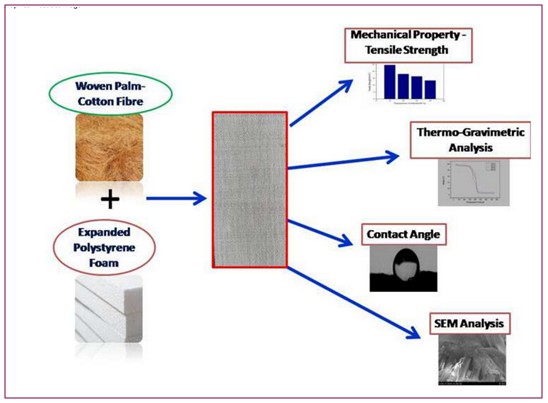
Preparation and Characterization of Hybrid Biocomposite Based on Woven Palm-Cotton Fibers and Used Expanded Polystyrene Beads

Pages 555-564

https://doi.org/10.22034/chemm.2021.138939

Sujaya Gangadharan, Athiyanathil Sujith, Venkattappan Anbazhagan

Abstract The ecological and environmental alertness has driven efforts for the development of novel materials like bio-composites for various end-use applications. In the present study, the hybrid bio composite, woven palm-cotton fiber (WPCF) reinforced in expanded poly styrene (EPS) foam matrix has been prepared and the potential of polystyrene foam waste as a matrix in biodegradable composite material was investigated. The WPCF/EPS bio composite has been prepared by a simple dip-up method. Mechanical, thermal, hydrophilic and morphological properties of the prepared bio composites have been analyzed by varying the weight percentage of Poly styrene composition. The results showed that WPCF/EPS hybrid bio composites are thermally stable up to 300 °C. The sample containing 40% EPS have shown maximum thermal stability. All samples exhibited good mechanical properties such as tensile properties, elongation at break and modulus of elasticity. SEM analysis showed better dispersion between the fiber and the matrix in optimum weight percentage of EPS containing sample (20%) and it revealed that micro structure and morphology of the sample was not improved by an increase in weight % of EPS. The properties exhibited by WPCF/EPS bio-composites showed similar mechanical properties on par with other natural fiber reinforced hybrid composite.