7.4 (Q1)
CiteScore2024
Q2
Web of Science
Volume & Issue: Volume 6, Issue 7, July 2022, Pages 501-570 
Number of Articles: 7

Determination of Some Heavy Metals in Dialysis Concentrates in Two Centers of Dialysis in Baghdad, Iraq

Pages 501-506

https://doi.org/10.22034/chemm.2022.335486.1464

Zainab K. Al-Dabagh, Suad. S. Al-Ghaban

Abstract The patients with renal failure require hemodialysis treatment and dialysis fluid is thus an essential component of such a treatment.
Hemodialysis is a method of treating renal failure which makes use of dialysis fluid to aid in re-establishment of electrolyte and acid-base balance. The water utilized for this process is derived from drinking water, although it has undergone an extra purification.
The purpose of this study is to evaluate the quality of dialysis fluids in two dialysis centers in Baghdad, over four seasons, from November 2020 to July 2021. A total of 24 water samples were analyzed as a part of the evaluation from three sites at each dialysis facility (tap, dialysis, and dialysis network distribution) of water samples. Chemical investigations were carried out after sampling water from the dialysis centers. The technique of Atomic Absorption Spectroscopy was used to determine the concentration of heavy metals in the water under investigation.
The findings revealed that there was a fluctuation in the quality of the observed dialysis water. 25% of water samples for Al level (normal 0.01 mg/L) was above the normal range for dialysis water. The highest value of aluminum was (0.04 mg/l) during the autumn and the lowest value was (zero) during the spring. 62.5% of water samples for chloramine level (normal 0.1 mg/l) were above the normal range for dialysis water. The highest level was (0.505 mg/l) during the autumn. When compared to the international standards, it was found as unacceptable. According to the results of the chemical investigation, the dialysis water quality suffers from the high Chloramine concentrations in all dialysis facilities.

Synthesis, Characterization and Thermal Analysis of Cr(III), Mn(II) and Zn(II)Complexes of a New Acidicazo Ligand

Pages 507-521

https://doi.org/10.22034/chemm.2022.335777.1467

Rasha Khider Hussain Al-Daffay, Abbas Ali Salih Al-Hamdani

Abstract The researchers wanted to make a novel azo imidazole as a follow-up to their previous work. We focused on the ligand 4-[(2-amino-4-phenylazo)-methyl]-cyclohexane carboxylic acid as a derivative of trans-4-(aminomethyl) cyclohexane carboxylic acid diazonium salt, synthesized a series of its chelate complexes with metal ions, and characterized these compounds using a variety techniques, including elemental analysis, FT-IR, LC-Mass, NMR and UV-Vis spectral process as well TGA, conductivity and magnetic quantifications. Analytical data showed that the Cr(III), Mn(II) and Zn(II)  complexes out to 1:1 metal-ligand ratio with octahedral geometry except Mn complex has tetrahedral geometry.

An Evaluation of the Activity of Prepared Zinc Nano-Particles with Extract Alfalfa Plant in the Treatments of Peptidase and Ions in Water

Pages 522-533

https://doi.org/10.22034/chemm.2022.336588.1470

Zainab Ridha Al-Bahadili, Abbas Ali Salih Al-Hamdani, Labeeb Ahmed Al-Zubaidi, Farqad Abdullah Rashid, Suha Mohamed Ibrahim

Abstract After harvesting, Alfalfa plant was washed, dried and ground to get fine powder used in treatment water. We used alfalfa plant with ethanol to made alcoholic extract and characterized it applying (GC-Mass, FTIR, UV) spectroscopy to determine active compounds. Alcoholic extract was used to prepare zinc nanoparticle. We characterized Zinc nanoparticles by using FTIR, UV, SEM, EDX Zeta potential and AFM. Zinc nanoparticle with Alfalfa extract and alfalfa powder was used to treat pollutant water with pesticides and negative ions by two methods, namely Batch and continuous processing. Batch process was used two times firstly, with Alfalfa plant to treat water affected by pesticides and negative ions, after 1h pesticides (glyphosate 44.76%, sulfon 49.21%) Negative ions (NO3 33.8%, NO2 46.8%, 17.2%) and when left it 5h to get treated off pesticides (glyphosate 64.52%, sulfon 69.38%), Negative ions (NO3 71%, NO2 80%, SO4 70%). Secondly, we used with Zinc nanoparticles to treat water after 1h pesticides (glyphosate 71.45%, sulfon 52.6%)  Negative ions (NO3 72.13%, NO2 14.50% SO4 78.30%) and when left 5h (glyphosate 81.26% sulfon 60.11%) Negative ions (NO3 79.55%, NO2 32.45%, SO4 86.80%), followed by continuous processing flowrate pertaining to pesticides (glyphosate 57.44%, sulfon 59.50%), Negative ions (NO3 32.24%, NO2 6.28%, SO4 65.57%). Zinc nanoparticles were treated in continuous process at concentration 10 ppm only for pesticides for 1h to get treated (glyphosate 77.22%, sulfon 100%) and concentration 50 ppm for treating pesticides (glyphosate 64.52%, sulfon 69.38%), Negative ions (75.41%, 18.69%, 90.70%). Comparing the two process, we found the continuous one more efficient than batch process.  Further, comparing alfalfa powder and zinc nanoparticle, we found treatment with zinc nanoparticle more efficient and most removal for organic and inorganic pollutant.

Micellar Properties of a Foam Extinguishing Agent Based on Fluorocarbon Non-Ionic and Hydrocarbon Cationic Surfactants in a Mixed System

Pages 534-547

https://doi.org/10.22034/chemm.2022.336908.1477

Mohamed Naous, Ahmed Halfadji, Abdelkader Chougui, Boumediene Bounaceur

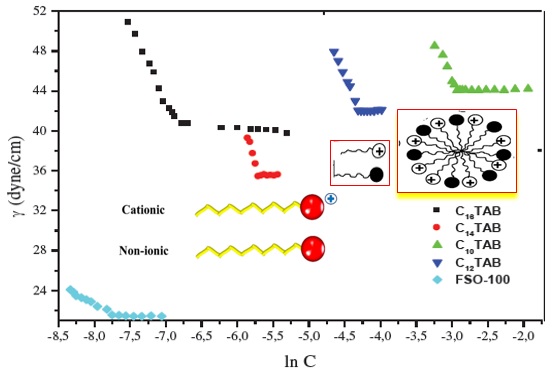
Abstract Fluorocarbon surfactant containing perfluorinated is the key component in aqueous film-forming foam extinguishing agent (AFFF), although its environmental concern is becoming more evident. In order to reduce the amount of this fluorinated surfactant while maintaining the micellar and surface properties, mixed systems based on fluorocarbon non-ionic and hydrocarbon cationic surfactants have received more attention with the aim of decreasing the environmental hazard of perfluorinated surfactants. The micellar properties, surface activity, and synergistic behavior of mixture systems of non-ionic fluorocarbon surfactant (undecafluoro-n-pentyl-decaoxyethylene ether (C5F11EO10)) and three cationic surfactants with different alkyl chain (n-alkyltrimethylammonium bromides: 10 (DTAB), 14 (TTAB) and 16 (CTAB)) are investigated. The effect of cationic chain length on physicochemical and thermodynamic properties are evaluated. Results obtained highlight a remarkable effect of reduction of the critical micellar concentration (CMC) with an increase in length of the chain; this effect is due to high the increase of hydrophobicity with the increase of the chain length. Furthermore, mixed system (C10TAB-C5F11EO10) has optimal synergy for minimizing surface tension. Also, the case of mixed micelles solutions rich on C5F11EO10, CMC has less steric hindrance among hydrocarbons and fluorocarbons, which are more or less similar to carbon chains. Finally, the C5F11EO10 suggests a synergy of CMC reduction with intermediate activity between C16TAB-C5F11EO10 and the C10TAB- C5F11EO10. Mixed systems (Foam) containing short-chain fluorotelomers tend to promote fewer toxic alternatives.

Synthesis, Structural, Thermal and Biological Studies of Ligand Derived from Anthrone with 4-Aminoantipyrine and its Metallic Complexes

Pages 548-559

https://doi.org/10.22034/chemm.2022.339536.1499

Weaam A.M. Al-Shammari, Sajid M. Lateef

Abstract This study presented the synthesis of ligand 4-(anthracen-9(10H)-ylideneamino)-1,5-dimethyl-2-phenyl-1,2-dihydro-3H-pyrazol-3-one (L2), synthesized from reaction of one equivalent of (Anthrone) with one equivalent for 4-aminoantipyrine and its complexes for metal ions [Mn(II), Co(II), Ni(II), Cu(II), Zn(II),Cd(II) and Hg(II)].  The ligand and their complexes were characterized by melting point measurement, elemental microanalysis C.H.N, FT-IR, UV, (1H, 13C-NMR and Mass spectroscopy only ligand) along with atomic absorption spectrophotometer, chloride contents, conductivity measurement, magnetic susceptibility and thermal gravimetric analysis only complexes, in addition to evaluating their biological activity against the types of bacteria. Based on data of all techniques suggested an octahedral geometry for complexes except complex [Ni(L)2] Cl2.H2O, the shape square planer and complexes Cd(II), Hg(II) and Zn(II) were shown. The shape tetrahedral appeared. The results showed biological activity against the types of bacteria for most of the synthesized ligand and its complexes.

Electrochemical Sensing of Theophylline using Modified Glassy Carbon Electrode

Pages 560-568

https://doi.org/10.22034/chemm.2022.336988.1476

Effat Sharifi Pour, Maryam Ebrahimi, Hadi Beitollai

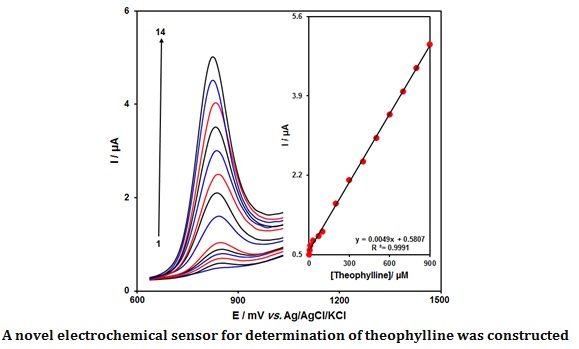
Abstract In this work, three dimensional NiO nanowrinkles (3D NiO-NWs) were prepared and used as electrode materials to modify the surface of a glassy carbon electrode (3D NiO-NWs/GCE). Then, differential pulse voltammetry (DPV), cyclic voltammetry (CV) and chronoamperometry (CHA) were employed to determine the electrochemical response of theophylline on as-fabricated sensor. The electrochemical theophylline oxidation was elevated on the modified electrode. The peak current on the modified electrode in phosphate buffer solution (PBS, 0.1 M, pH=7.0) showed a linear elevation with an increase in the theophylline concentration (0.1-900.0 µM), with a narrow detection limit of 0.03±0.001 µM.

Micro Spectrophotometric Determination and Cloud Point Extraction of Aspirin with Iron (III) in Pure Form and Pharmaceutical Drugs

Pages 569-570

https://doi.org/10.22034/chemm.2022.332256.1449

Noora Saad Mubder, Maha Al-Tameemi, Hawraa Mahmood, Nahlah Kadhim Salman, Haider Al-Neshmi

Abstract Cloud-point extraction and molecular spectrophotometry in tandem was developed and suggested as a method for detecting aspirin and iron (III) ions in pharmaceutical. In a dilute acidic medium, aspirin interacted with Fe(III) ions to produce a brightly colored [Fe(III)-aspirin] complex, which was originally as a mediated extractant, extracted into Triton X-114 micelles, then determined by spectrophotometry at a wavelength maximum of 527 nm. For target analytes, all experimental variables were previously adjusted to accomplish this purpose. The results showed that pre-concentration factors of 80 for aspirin resulted in a detection limit of 0.23 g mL-1 having a linear range of (5-120) gmL-1 (r= 0.9998). For aspirin, a mean recovery percentage of 98. ± 1.09% was recorded, with precision (RSD %) ranging from 0.04-0.66 %.