7.4 (Q1)
CiteScore2024
Q2
Web of Science
Volume & Issue: Volume 3, Issue 4, July and August 2019, Pages 392-518 
Number of Articles: 9

Sulfate Sulfuric Acid (SUSA)/NaNO2: Efficient Procedure for N-Nitrosation of Secondary Amines and DFT Studies of the Products

Pages 392-407

https://doi.org/10.22034/chemm.2018.150101.1095

Lotfi Shiri, Davood Sheikh, Sakineh Janinia, Masoome Sheikhi

Abstract We present the preparation and characterization of sulfate sulfuric acid (SUSA) for the first time. The SUSA showed the best activity in efficient nitrosation of secondary amines under mild condition with excellent yields. Sulfate sulfuric acid (SUSA), is a safe, stable and recyclable solid acid and is a suitable reagent for many organic reactions. The quantum theoretical calculations for products (2a-j) were performed by density functional theory (DFT/B3LYP/6-31+G*). Natural charge, frontier molecular orbitals (FMOs), total density of states (DOS), molecular electrostatic potential (MEP) and NBO analysis of the products were investigated by theoretical calculations. Also, molecular properties such as ionisation potential (I), electron affinity (A), chemical hardness (η), electronic chemical potential (μ) and electrophilicity (ω) were obtained for products.

Synthesis, Characterization, Kinetics, Thermodynamic and Antimicrobial Studies of Fe(III), Cu(II), Zn(II), N,N'-Bis(2-hydroxy-1,2-diphenylethanone)ethylenediamine Complexes

Pages 408-424

https://doi.org/10.22034/chemm.2018.147922.1085

Moses Saviour Iorungwa, Raymond Wuana, Samuel Terungwa Dafa

Abstract Schiff base ligand derived from benzaldehyde and ethylenediimine and its Fe(III),Cu(II) and Zn(II) complexes were synthesized. The ligand N,N’-Bis(2-hydroxyl-1,2-diphenylethanone)ethylenediamine(B2HDE)and its complexes were characterized by molar conductivity, melting point, solubility test and spectrometrically (IR and UV-Vis). The Kinetics of complex formation obtained from a plot lnkobs verses 1/T, thermodynamic parameters were obtained from plots of ln(kobs/T) verses 1/T and antimicrobial activities of the ligand and its complexes were tested. The solubility results showed that B2HDE and its complexes were soluble in dimethylsulphoxide, dimethylformanide and acetone while the melting point of ligand and complexes showed they are fairly stable. The complexes molar conductivity indicated that they are non-electrolytes. The IR spectra showed a bidented ligand which coordinated through azomethine nitrogen and hydroxyl oxygen atom. UV-Vis results confirmed the complexation of the metal and ligand with a tetrahedral geometry for both complexes and the activation energy (Ea) obtained were positive Ea indicating that, the rate of formation increased with increasing temperature. The kinetic results showed that increase in time and temperature increased the yield of the complexes. The results of thermodynamics parameters showed the formation of an activated complex via an associative pathway. Antimicrobial studies results of complexes were higher than the one found for the free ligand.

Different Interface Engineering in Organic Solar Cells: A Review

Pages 425-441

https://doi.org/10.22034/chemm.2018.150142.1096

Oluwatobi O. Amusan, Hitler Louis, Saud-uz- Zafar, Adejoke T. Hamzat, Dass M. Peter

Abstract The global quest for reliable sources of energy has led to the development of Organic solar cells (OSCs)/ Organic photovoltaics (OPVs). Over the past few years, they have shown great potentials and use as low cost devices for conversion of solar energy. OSCs are designed from different interface layers from different materials which form a major determinant for their energy conversion efficiency. The recent development in the modifications in design and engineering of these interface materials have shown increased power conversion efficiency (PCE%) of Organic photovoltaics. Interface materials are conductors, semiconductors or non-conductors which provide selective contact for carriers, determine polarity and acts as protective layers. This review discusses different materials which are used as interface materials as well as their structure and engineering.

Molecular Docking Studies of Novel Aminopyrimidines as Potent Antifungal Agents

Pages 442-450

https://doi.org/10.22034/chemm.2018.151655.1100

Judy Jays, S Mohan, J Saravanan

Abstract Candida albicans is an opportunistic fungal pathogen that causes candidiasis in human hosts. Candidiasis includes a multitude of fungal infections, including invasive fungal infections, where most patients are immunocompromised; hence, the success of treatment is determined by the efficacy of the antifungal agent. However, with the increase in resistance to the existing drugs, the availability of effective antifungal agents is becoming scarce.
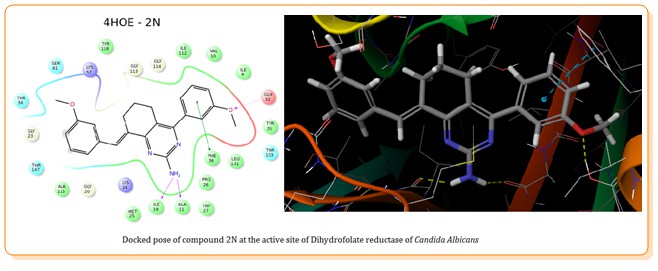
Many pyrimidine derivatives exhibit powerful antifungal activity. In this study, In silico antifungal activity was carried out on twenty novel aminopyrimidine derivatives to identify the specificity of the pyrimidine analogues for the antifungal targets using ‘Glide’. Molecular docking studies were conducted on two antifungal targets; Dihydrofolate reductase of C. albicans (PDB ID: 4HOE); N-myristoyl transferase of C. albicans (PDB ID: 1IYK); energy minimization of title compounds was carried out using LigPrep, the protein targets were optimized and minimized, a 3-dimensional grid was generated at the active site, and molecular docking was carried out at both the standard precision (SP) and extra precision (XP) modes. The docking poses were ranked according to their docking scores (GScore) and their binding energy with the enzyme (Emodel). The obtained results for the docking of the title compounds with dihydrofolate reductase of C. albicans are quite promising. Molecular docking suggest that compounds 2N and 2A are potential inhibitors of  dihyfrofolate reductase and are specific in binding at the active site of the enzyme. They form pi-pi stacking interactions with PHE 36 at the active site of the protein, similar to the standard drug. However the test compounds show lower docking scores against N-myristoyl transferase of C. albicans indicating that they may not be effective against the fungal protein.

Preparation and Evaluation of Herbal Formulation Using Natural Extract

Pages 451-456

https://doi.org/10.22034/chemm.2018.146968.1079

A. Dongarwar, Tulsidas Nimbekar, T. Parshuramkar, N. Indurwade

Abstract Butea monosperma and Psidium guajava are traditional important medicinal plants. The plants were used in Ayurvedic unani and Siddha medicine for various ailments. Antibacterial activity was studied using extracts of Butea monosperma and Psidium guajava by agar well-diffusion method against E. coli and S. aureus. The ethanolic extracts of Butea monosperma flowers showed antibacterial activity against E. coli and S. aureus. In the same manner Psidium guajava leaf, extract showed antibacterial activity against E. coli and S. aureus. The objective of the present investigation was to formulate and evaluate herbal gel using specified concentration of powdered extracts of Butea monosperma flower and Psidium guajava leaves. 

Cu Nanoparticle: Synthesis, Characterization and Application

Pages 457-480

https://doi.org/10.22034/chemm.2019.154075.1112

N.S. Powar, V. J. Patel, P.K. Pagare, R.S. Pandav

Abstract The applications of copper nanoparticle are gradually increased because of Cu is inexpensiveness and high abundance in nature. However, synthesis of copper nanoparticles is very challenging because of transformation from Cu nanoparticles into copper oxide in presence of air, though colloidal Cu NPs have significantly catalytic activity and biological applications. This review article exploring the synthesis of copper nanoparticles by different methods such as wet chemical, microemulsion, micro-oven assisted and thermal decomposition, moreover, explains about green and biological modes of synthesis. Some of the characterization methods for copper nanoparticle have discussed seem, electron microscopes and X-ray spectroscopy. Furthermore, applications of degrading treatment of textile effluents containing methylene blue dye and expose the mechanism of degradation. The copper nanoparticles show a catalytic activity in organic transformation, while have mentioned the biological application for anti-microbial and wound healing of copper NPs. 

Improved Photostabilization of Chlorpyrifos Insecticide with Novel Benzil Derivatives

Pages 481-493

https://doi.org/10.22034/chemm.2018.151723.1101

Gautam M. Patel, Hemant S. Parmar, Pradeep T. Deota

Abstract Chlorpyrifos, an organophosphorus insecticide, is widely used in agricultural and non-agricultural areas all over the world. During field application, it readily undergoes degradation due to microbial decomposition, hydrolysis, volatilization and photolysis. Among these, photodegradation is one of the major pathways for its decomposition on field. In the present study, eight novel benzil derivatives and their application for the photostabilization of chlorpyrifos under UV light are reported. The percentage recovery of chlorpyrifos after UV irradiation (in the presence and absence of the benzil derivatives) is obtained by HPLC analysis. Results indicate significant enhancement in the photostabilization of chlorpyrifos using these benzil derivatives (96.63% recovery) in comparison to 2,4-dihydroxy benzophenone taken as  a reference photostabilizer (78.80% recovery). Enhanced photostabilization, in case of benzil derivatives, is attributed to the assembly of two hydroxy and keto pairs in a single structure. 

Validated Stability Indicating RP-HPLC DAD Method for Simultaneous Determination of Amitriptyline Hydrochloride and Pregabalin in Presence of Stress degradation products in tablet dosage form

Pages 494-508

https://doi.org/10.22034/chemm.2019.154554.1107

Amit J. Vyas, Grishma P. Nathwani, Ajay I. Patel, Nilesh K. Patel, Ashok B. Patel

Abstract Background: High Performance liquid chromatography (HPLC) is an integral analytical tool in assessing drug product stability. HPLC methods should be able to separate, detect, and quantify the various drug-related degradants that can form on storage or manufacturing, plus detect any drug-related impurities that may be introduced during synthesis.
Objectives: A simple, economic, selective, precise, accurate and stability indicating RP-HPLC (Reversed phase–HPLC) method was developed and validated for analysis of Amitriptyline Hydrochloride (AMI) and Pregabalin (PGB) in the formulation.
Method: Reversed-phase chromatography was performed on a C18 column with buffer (potassium dihydrogen phosphate) pH 4.0 and acetonitrile, (40:60 %v/v), as mobile phase at a flow rate of 1 mL/min.
Result: The detection was performed at 230 nm (nanometer) and sharp peaks were obtained for PGB and AMI at retention time of 4.4 and 9.6 min, respectively. The detection limits were found to be 3.00 µg/mL and 0.59 µg/mL and quantification limits were found to be 9.11 µg/mL and 1.79µg/ml for Pregabalin and amitriptyline hydrochloride, respectively. The method was validated for accuracy, precision, reproducibility, specificity, robustness and detection and quantification limits, in accordance with ICH (international council of hormonization) guideline.
Conclusion: Stress study was performed on Pregabalin and amitriptyline hydrochloride and it was found that these degraded sufficiently in all applied chemical and physical conditions. Thus, the developed RP-HPLC method was found to be suitable for the determination of both the drugs as well as stability samples of tablets containing various excipients.

N1,N1,N2,N2-Tetramethylethylenediaminium-N1,N2-disulfonic Acid Trifluoroacetate as Highly Effectual and Dual-Functional Catalyst for the Reaction of β-Ketoesters with Aryl Aldehydes and Urea/Thiourea

Pages 509-518

https://doi.org/10.22034/chemm.2019.157916.1111

Mostafa Karami, Bentolhoda Gholami, Tahereh Hekmat-Zadeh, Abdolkarim Zare

Abstract In this research, the one-pot multi-component reaction of β-ketoesters with aryl aldehydes and urea/thiourea has been performed using a dual-functional ionic liquid-catalyst namely N1,N1,N2,N2-tetramethylethylenediaminium-N1,N2-disulfonic acid trifluoroacetate ([TMEDSA][TFA]2) in solvent-free conditions. By reason of dual-functionality of the catalyst (possessing acidic and basic sites), and also having two numbers of each site, it was highly effectual and general catalyst, and afforded the products {3,4-dihydropyrimidin-2-(1H)-ones and 3,4-dihydropyrimidin-2-(1H)-thiones} in short times with excellent yields. Moreover, a plausible mechanism based on dual-functionality of the catalyst has been proposed.