7.4 (Q1)
CiteScore2024
Q2
Web of Science
Volume & Issue: Volume 7, Issue 7, July 2023, Pages 509-580 
Number of Articles: 5

Synthesis, Identification, and Antibacterial Effect Assessment of Some New 1,4-Thiazepines, Derived from Substituted Diphenyl Acrylamides and Diphenyl Dienones

Pages 509-523

https://doi.org/10.22034/chemm.2023.392659.1668

Saad Salem Jasim, Jawdat Hilmi Abdulwahid, Shakhawan Beebany, Bari Lateef Mohammed

Abstract Some new 1,4-thiazepine derivatives (J16-J30) have been successfully synthesized through the reaction between each of diphenyl acryl amides (J1-J10) and diphenyl dienones (J11-J15) with ortho-mercapto aniline. The reaction was performed in an alkaline medium using ethanol as a solvent. The diphenyl acryl amides were prepared from the condensation reaction of para-substituted acetanilides with different para benzaldehydes, while para-substituted benzaldehydes were reacted with acetone to produce the diphenyl dienones. All the prepared compounds have been identified, using visible and ultraviolet radiation spectrum, and infrared spectrum. Some of the new synthesized compounds have been diagnosed and confirmed their structures by proton and carbon nuclear magnetic resonance spectrum (1H-NMR and 13C-NMR, respectively). The purity of prepared compounds was confirmed by relying on thin-layer chromatography (TLC) results. The biological effect of these derivatives was assessed against certain types of gram-positive bacteria (Streptococcus Pneumonia and Staphylococcus Aureus) and gram-negative bacteria (Escherichia Coli, Pseudomonas Aeruginosa, and Proteus Moralities). The results showed a high antibacterial effect towards both types of the used bacteria at high concentrations, while the prepared compounds behaved differently at low concentrations. The results indicated that most of new thiazepines revealed a high antibacterial effect towards both types of the tested bacteria at high concentrations (100 mg/mL), while behaved oppositely at low concentrations (10 and 50 mg/mL). This is related to high concentration effect resulting in an increase for inhibition zone diameter. The highest antibacterial effect was observed for compounds (J17, J19, J21, J24, J25, J26, J28, and J30) at 100 mg/mL. One of the reasons could be the presence of halogenes and nitro groups compared to the other compounds as a result of electron withdrawal groups role.

Ultrasound-Assisted Preparation and Optimization of Natural Flavoring Nanoemulsion for Dairy Products Based on Pistacia Khinjuk in Lab Scale

Pages 524-539

https://doi.org/10.22034/chemm.2023.382181.1649

Masoumeh Khanahmadi, Fatemeh Shahrezaei, Mahdieh Sharifi, Ghasem Rezanejade Bardajee

Abstract Encapsulation process is employed to preserve flavor from inadmissible interactions with food, minimizing flavor-flavor interactions, guarding in contradiction of light-induced reactions or oxidation, and increasing flavors shelf-life or allowing an organized release. The aim of this study is to define the preparation and benefits of encapsulation of Pistacia khinjuk gum essential oil as a flavor via nanoemulsion process. Nanoemulsion was prepared by sonicating technique with a probe-type ultrasonicator at varying amounts of surfactant and glycerol. The design expert software was used to optimize the size of nanoemulsion. The nanoemulsion was characterized by DLS analysis, and TEM. The antibacterial activity of nanoemulsion and gum essential oil was performed at four different levels (0.01, 0.1, 1, and 10 %) on ten strains of bacteria. The cytotoxicity of gum essential oil and nanoemulsion was also evaluated toward β-TC3, MCF7, and HT29 cell lines.

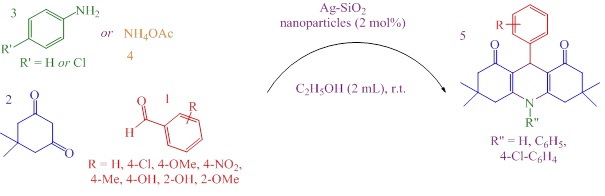
Ag-SiO2 Nanoparticles: Benign, Expedient, and Facile Nano Catalyst in Synthesis of Decahydroacridines

Pages 540-551

https://doi.org/10.22034/chemm.2023.386678.1653

Morteza Farajpour, Seyed Mohammad Vahdat, Seyed Meysam Baghbanian, Mehdi Hatami

Abstract A simple approach for component reaction between aldehydes, anilines or ammonium acetate, and dimedone in ethanol as a solvent is studied using Ag-SiO2 nanoparticles. This approach results for the synthesis of various decahydroacridines in appropriate yields (80-94%). The use of Ag-SiO2 nanoparticles as a heterogeneous catalyst lets a clean procedure.

Static and Dynamic Study of Novel 4-Formyl-N-Hexadecyl-N,N-Dimethylbenzenaminium Bromide Synthesized as a Corrosion Inhibitor Use in Petroleum Wells Acidizing Process

Pages 552-568

https://doi.org/10.22034/chemm.2023.395919.1677

Zaidoun K. Kuraimid, Abd El-Aziz S. Fouda S. Fouda, Dawood S. Abid

Abstract This study showcases the innovative synthesis of 4-formyl-N-hexadecyl-N,N-dimethylbenzenaminium bromide (FHDB) using a reaction of 1-Bromohexadecane and 4-di methyl amino benzaldehyde. The compound was then characterized through various techniques such as FT-IR, 1H-NMR, and 13C-NMR, along with physical property measurements. Thereafter, the synthesized FHDB was tested for its corrosion inhibition properties on C-steel in 6M HCl, with a focus on kinetics and thermodynamics using potentiodynamic polarization (PDP). The surface changes of the C-steel were observed through Scanning Electron Microscopy (SEM) and Atomic Force Microscopy (AFM). The study revealed that FHDB exhibited strong inhibitory properties against corrosion in 6M hydrochloric acid solutions, with an adsorption pattern on the steel surface in agreement with Langmuir adsorption isotherm. The results, which include corrosion and electrochemical testing data, demonstrate that the experimental corrosion inhibitors are typically practically equal between the fluid flow study (dynamic simulations) and the static study, which is attributable to the FHDB chemical structure.

Efficient Removal of Fluoride Using Sol-Gel Processed Nano Magnesium Oxide

Pages 569-580

https://doi.org/10.22034/chemm.2023.393347.1671

Lakshmi Jayanthi Juturi, Rohinikumar Palavalasa, Sneha H. Dhoria, Subbarao Jampani, Vijay Miditana, Gouthami Jalem

Abstract Urbanization and increased industrialization are both contributing to a very high level of stress on our water environment, which is reducing the supply of clean water. Water pollution affects the ecosystem and is a major concern for humans, flora, fauna, and the environment. Fluoride is a pollutant that is persistent and not biodegradable; it builds up in the soil, plants, animals, and people. Therefore, understanding its removal and using the best method with the greatest efficiency is required. Likewise, adsorption is an affordable and easy technique that could be adopted at the household level. The Sol-Gel process was used for the nano-MgO synthesis, which has a cost-effective recovery of the material. SEM, Fourier transform infrared spectroscopy, and X-ray diffraction analysis were done to characterize the synthesized nanomaterial. The produced nano magnesium oxide (nano-MgO) was evaluated for the defluoridation process. The results indicated that the occurrence of ions like bicarbonate and phosphate highly favors the adsorption of nano-MgO. Fluoride elimination using nano-MgO was achieved in this study by doing experiments in batches and considering three-time intervals. The optimal time for the utmost removal of fluoride was found to be 15 minutes, during which the concentration decreased from 8 ppm to 3.1 ppm.