7.4 (Q1)
CiteScore2024
Q2
Web of Science
Volume & Issue: Volume 7, Issue 2, February 2023, Pages 106-182 
Number of Articles: 6

Design, Synthesis, and Biological Activity of New Thiazolidine-4-One Derived from Symmetrical 4-Amino-1,2,4-Triazole

Pages 106-111

https://doi.org/10.22034/chemm.2023.362512.1610

Fayyadh Abed Nashaan, Muna Sameer Al-Rawi

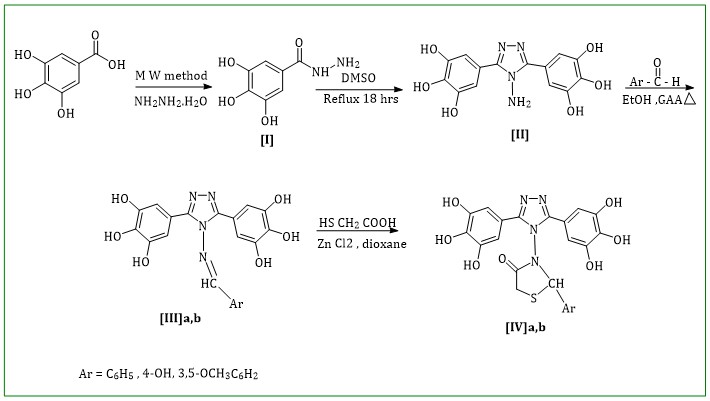
Abstract Thiazolidine-4-one derivatives (IV)a,b containing 1,2,4-triazole rings linked to 3,4,5-trihydroxyphenyl moiety were designed, synthesized, and biological evaluated for the antibacterial/antifungal activities. These derivatives (IV)a,b were achieved from many sequence reactions. A multi-step reaction protocol was used that began with the first step involved a new and very fast one-pot solventless greener microwave-assisted method of synthesis galloyl hydrazide (I) from gallic acid and hydrazine hydrate. The galloyl hydrazide (I) was used as the starting materials for synthesizing new 5,5'-(4-amino-4H-1,2,4-triazole-3,5-diyl) bis (benzene-1,2,3-triol) (II) via a reflux cyclization process of galloyl hydrazide in DMSO. On the other hand, new Schiff base (III)a,b was prepared via condensation reaction of the symmetrical 4-amino-1,2,4-triazole compound (II) and substituted aromatic aldehyde in ethanol. Finally, the treatment of schiff bases (III)a,b was done with thioglycollic acid in refluxing dioxin by using zinc chloride (II) to afford the target thiazolidine-4-one derivatives (IV)a,b. The structure identification of the newly compounds (I-IVa,b) was elucidated by FT-IR,1H-NMR, and 13C-NMR. The new synthetic derivatives were subjected for antibacterial/ antifungal activity by using two type of Gram-positive and Gram-negative bacteria also test it against to Candida albicans as a fungi sample.
Synthesis and Characterization of Chrome(VI) Ion/Iron Oxide/Chitosan Composite for Oxidation of Methylene Blue by Photo-Fenton Reaction

Pages 112-122

https://doi.org/10.22034/chemm.2023.361921.1608

Yaman Khalid Sadiq, Khulood A. Saleh

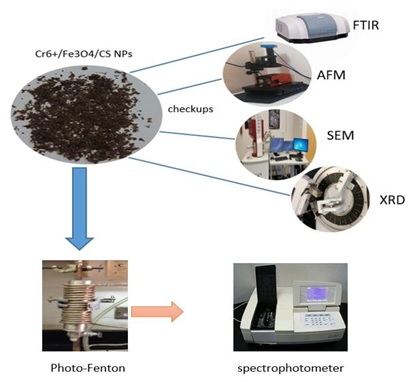
Abstract Removing heavy metal ions from organic contaminants by industrial wastewater treatment systems is a difficult challenge. In this study, organic contaminants were degraded using functional composite hydrogels with photo-Fenton reaction activity. Chromium, chitosan, Fe3O4, and other ingredients go into the making of the hydrogel. Following are some factors that changed photo-Fenton activity: (pH, H2O2 conc., temp, and exposure period). AFM was used to analyze the composite's morphology and typical diameter (AFM). It investigated how much chromium adsorbs on chitosan (BET). After 60 minutes of UV exposure, The MB dye degradation in the Cr6+/Fe3O4/CS hydrogel composite was 90.4%.

Preparation and Identification of New 1,4-Bis(5,3-substituted-2,3-dihydro-1H-pyrazole-1-yl)buta-1,4-dione Derivatives with their Antibacterial Effect Evaluation

Pages 123-136

https://doi.org/10.22034/chemm.2023.365060.1614

Shakhawan Beebany, Saad Salem Jasim, Mohammad M.Al-Tufah, Sevgi Samih Hidayet Arslan

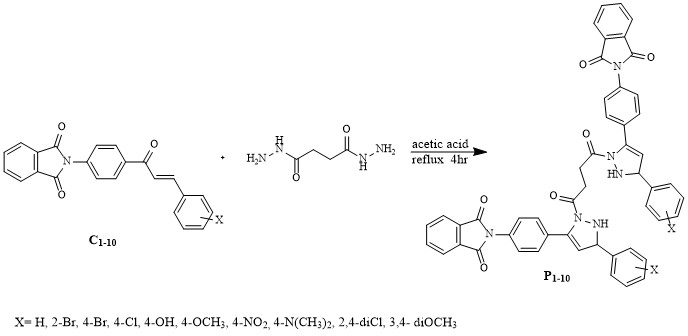
Abstract A new series of 5,3-substituted-2,3-dihydro-1H-pyrazole derivatives (P1-10) have been synthesized via a cyclization reaction of substituted chalcones with succinichydrazide. Structures of the prepared compounds were identified by FT-IR, and some of them were characterized by Nuclear Magnetic Resonance for proton 1H-NMR and Nuclear Magnetic Resonance for carbon 13C-NMR. The heat of formation (HF) and steric energy (SE) have been calculated using (MOPAC) and (MM2) methods, respectively, using (CS-Chemoffice-version 6.0) program. Additionally, the biological activity for final products has been evaluated against gram-positive (staphylococcus aureus and staphylococcus epidermidis) and negative bacteria (escherichia coli and pseudomonas aeruginosa). 

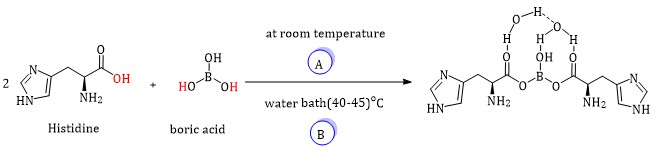
Synthesis of New Homogeneous Amino Acids Compound with Boron and Some of its Metal Complexes

Pages 137-155

https://doi.org/10.22034/chemm.2023.363773.1613

Hiba Modar Shihab, Asmaa Mohammed Noori Khaleel

Abstract Synthesis of a synthetic ligand (L) by mixing histidine and boric acid in molar ratios of 2:1. The complexes of transition metal were prepared by reacting CoCl2.6H2O, NiCl2.6H2O, and CuCl2.H2O with (L) in molar ratios of 2:1 (L:M). All produced compounds are investigated by using spectral methods UV-Vis, FT-IR, 1H-NMR, and AAS. In addition to the melting point, thermal analysis, magnetic susceptibility measurement, micro elemental analysis, and determination of chloride content. All complexes of transition metal were proposed to have octahedral geometries. Every component was an electrolyte as well as a paramagnetic one. All the complexes of transition metal produced were shown to be antibacterial and antifungal against the bacteria Staphylococcus aureus, Klebsiella pneumonia, and the fungus Candida. The anti-cancer activities of the ligand and copper complex were also studied.

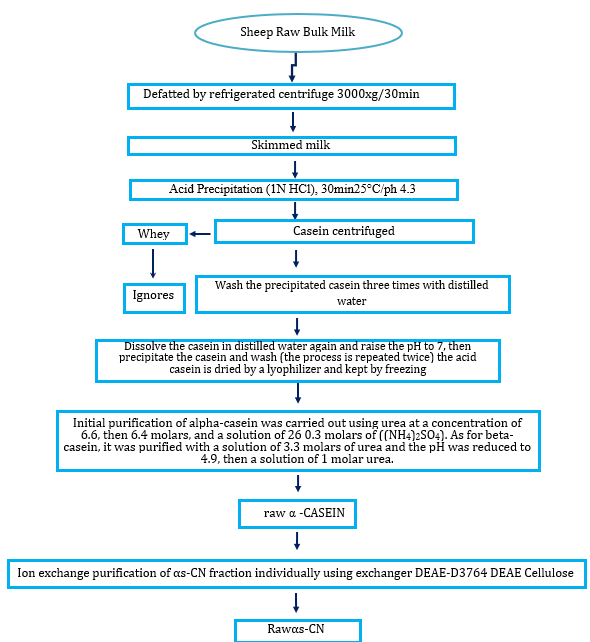
Isolation and Purification of αs-CN from Sheep Milk and Measuring the Effectiveness of Its Enzymatic Hydrolysis in Inhibiting ACE1

Pages 156-166

https://doi.org/10.22034/chemm.2023.366342.1618

Shatha Jameel AlKhalidy, Kifah Saed Dosh

Abstract Casein is a biologically and physiologically complex fluid that contains proteins, water, fat, lactose, minerals, and vitamins as its principal constituents that might support the treatment of human body. Isolation of casein using urea and salts was used. Then, casein was partially purified using DEAE-Cellulose and Sephadex-G-75. The hydrolysis degree was estimated after incubation with pepsin, trypsin, and a mixture of them. αs-CN was partially purified with one peak after DEAE-cellulose ion exchange and there is also one peak that appeared after the Sephadex G-25 gel filtration technique. The maximum hydrolysis was gained after 8 hours of incubation with hydrolyzing enzymes. αH hydrolysates of αs-casein showed that the inhibition rate reached about 67% after 8 hours of incubation with a mixture of pepsin and trypsin with a hydrolysis concentration of 0.114 μmol. Results showed that casein extracted from sheep milk can be highly purified using both ion exchange and gel filtration chromatography. Hydrolysis of αs-CN produces low molecular weight protein using pepsin and trypsin and a mixture of them. The αs-CN has a high inhibition rate of the angiotensin-converting enzyme (ACE). 

Experimental and Theoretical Studies on Corrosion Inhibition Performance of Pyridine Derivatives for Mild Steel in Acid Solution

Pages 168-182

https://doi.org/10.22034/chemm.2023.367116.1622

Basma A. Hadi, Hiba H. Ibraheem

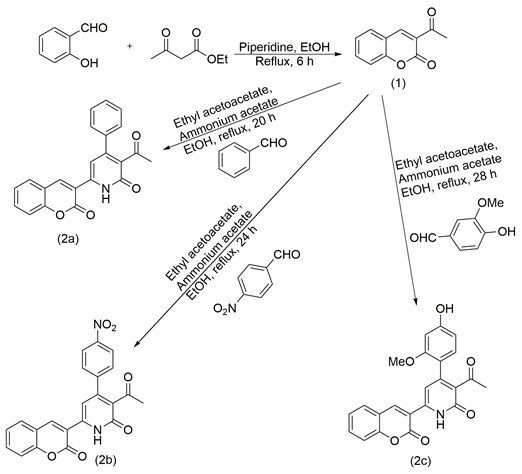
Abstract Substituted pyridine derivatives have been synthesized by reacting 3-acetyl-2H-chromen-2-one with suitable aldehydes using ethyl acetoacetate and ammonium acetate to afford 3-acetyl-4-( substituted -phenyl)-6-(2-oxo-2H-chromen-3-yl) pyridin-2(1H)-one (2a-c). TLC has checked the homogeneity of all three synthesized compounds. Their IR, and 1H-NMR, which can reduce mild steel corrosion in 0.5 M hydrochloric acids were investigated using weight loss measurements and surface detection techniques, with scanning electron microscope (SEM) investigations utilized to identify the used surface technique. The inhibition efficiency was more significant than 99.62%. The formation of protective adsorption layers on the steel surface was credited with excellent inhibitor results. To better understand the inhibition process, quantum chemical calculations were used.