7.4 (Q1)
CiteScore2024
Q2
Web of Science
Volume & Issue: Volume 8, Issue 4, April 2024, Pages 234-315 
Number of Articles: 5

Synthesis and Identification of Chromium (III) Complex with 2-Amino-3-(1-hydrogen-indol-3-yl) Propanoic Acid Ligand

Pages 234-240

https://doi.org/10.48309/chemm.2024.434059.1756

Reihaneh Beiraghi Toosi, Mohammad Hakimi, Mehdi Dadmehr

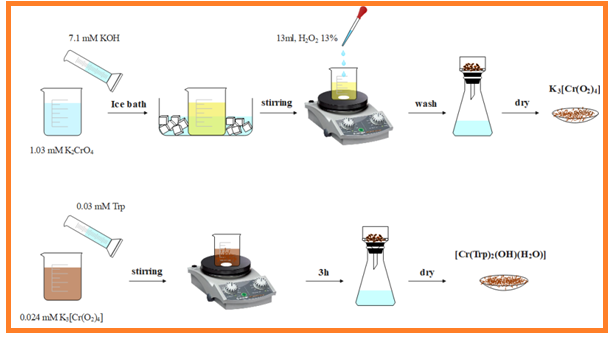
Abstract In this study, the ligand 2-amino-3-(1-hydrogen-indol-3-yl) propanoic acid (Trp) was used to react with chromium metal ion to prepare complex [Cr (Trp)2(OH)(H2O)].This compound was synthesized for the first time and identified by elemental analysis, FT-IR, UV-Vis, conductivity, and melting point techniques. In the FT-IR spectrum of the complex [Cr (Trp)2(OH)(H2O)], the vibrational bands of the acetate and NH2 groups have shifted to lower energies than the free ligand. In addition, the presence of the Cr-N vibration band at 424 cm-1 is due to the coordination of the ligand to chromium metal. The hexa-coordinated complex of Cr with the octahedral geometric structure including [Cr (Trp)2(OH)(H2O)] is proposed.

Investigating Energy Saving in the Design of the Oil and Gas Industry Safety Training Center with the Perspective of Using Renewable Resources

Pages 241-256

https://doi.org/10.48309/chemm.2024.441854.1762

Maryam Zamani Motlagh, Maral Amiri

Abstract In the field of safety in the oil and gas industry, fire training centers are one of the most effective places that provide safety services in the three sectors of training, prevention and combat. Therefore, the design and construction of safety and rescue centers, the use of machines and the optimization of operation, increase the efficiency of the aid and rescue stations. The aim of the present study is to identify and investigate the amount of thermal comfort indicators and planning, sustainable development, climate design of architecture and the use of renewable resources in the design of the training center with climatic data and energy saving in the design of the oil and gas industry safety training center from the perspective of use. All buildings must be energy efficient buildings. The principle of saving resources, on the one hand, deals with the proper use of non-renewable resources and energy such as fossil fuels, in order to reduce consumption, and on the other hand, it pays serious attention to the control and use of natural resources as best as possible as renewable and lasting reserves. The results of the study showed that the use of pipes with a high thermal coefficient, thermal insulations suggested according to the study, thermal packages with renewable energies and adhesives with a thermal conductivity coefficient higher than 0.375 are very effective. Conducting the present study showed that the use of wastewater distribution and recycling of the resulting water to the environment using international standards saves water consumption by 29%.

Fe3O4@SiO2@Mel-Rh-Cu: A High-Performance, Green Catalyst for Efficient Xanthene Synthesis and Its Application for Magnetic Solid Phase Extraction of Diazinon Followed by Its Determination through HPLC-UV

Pages 257-278

https://doi.org/10.48309/chemm.2024.442693.1767

Sahar Peiman, Behrooz Maleki, Milad Ghani

Abstract A novel, high-performance, recyclable heterogeneous catalyst functionalized with melamine was advantageously prepared and rhodanine on magnetic silica was successfully carried out. After that, the Cu ions were coordinated with the existing ligands decorated on the magnetic silica surface. This catalyst was identified by different analyses and acted as a recoverable catalyst for xanthene synthesis. Its advantages include the solvent-free conditions of the reaction, the high efficiency of the products in a short period of time, as well as its simple collection from the reaction environment. Moreover, the prepared sorbent has been developed for the extraction of diazinon from different real samples through magnetic solid phase extraction (MSPE). Under optimal conditions, the linear range for measuring diazinon was 0.5-200 µg L-1. The coefficient of determination (R2) was 0.9985. The limit of detection (LOD) of the method was 0.08 μg L-1. Relative standard deviation values (RSD%) for the concentration of 10.0 μg L-1 and 100 μg L-1 were between 5.3% and 5.9%. Finally, the proposed method was used to determine diazinon in orange and agricultural water. The results showed that the percentage of relative recovery of the selected toxin in the studied real samples was between 92 and 105.
Moreover, the prepared sorbent has been developed for the extraction of diazinon from different real samples through magnetic solid phase extraction (MSPE). The parameters affecting the extraction were optimized by response surface methodology (RSM). The optimal extraction conditions were 15 min for contact time, 7 mg for sorbent amount, and 0% (w/v) for NaCl concentration.

Moreover, 20 µL of methanol was used to elute the extracted analyte. Under optimal conditions, the linear range for measuring diazinon was 0.5-200 µg L-1. The coefficient of determination (R2) was 0.9985. The limit of detection (LOD) of the method was 0.08 μg L-1. Relative standard deviation values (RSD%) for the concentration of 10.0 μg L-1 and 100 μg L-1 were between 5.3% and 5.9%. Finally, the proposed method was used to determine diazinon in orange and agricultural water. The results showed that the percentage of relative recovery of the selected toxin in the studied real samples was between 92 and 105.

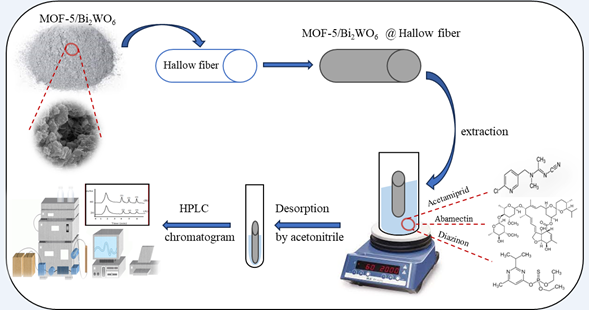
Synthesis of MOF-5 Modified Bi2WO6 Polyoxometalate Accommodated on the Pores of Hollow Fiber for HF-SPME of Acetamiprid, Abamectin and Diazinon and their Determination by High Performance Liquid Chromatography-Ultraviolet

Pages 279-292

https://doi.org/10.48309/chemm.2024.445733.1772

Mohammad Javad Aghajani, Milad Ghani, Jahan Bakhsh Raoof

Abstract In this study, metal organic framework-5/ Bi2WO6 (MOF-5/Bi2WO6) composite was synthesized for using in hollow fiber solid phase microextraction (HF-SPME) for separating acetamiprid, abamectin, and diazinon as the model compounds. To use the prepared adsorbent in the HF-SPME configuration, propylene hollow fiber was soaked in the methanolic mixture of adsorbent for accommodating the sorbent inside the pores of hollow fiber. In the next step, various parameters were optimized. Under optimal condition, the linear ranges for measuring acetamiprid, abamectin and diazinon were 0.2-100 µg L-1, 0.2-100 µg L-1, and 0.5-200 µg L-1, respectively. The coefficients of determination (R2) were 0.9961 to 0.9982. The limits of detection (LODs) of the method for acetamiprid, abamectin, and diazinon were 0.06, 0.05, and 0.14 μg L-1, respectively. Moreover, the enrichment factors (EFs) were 64, 66, and 62 for acetamiprid, abamectin, and diazinon, respectively. In addition, the absolute recoveries (ARs%) were in the range of 62-64%. Relative standard deviation values (RSD%) for the concentration of 2.0 μg L-1 , 10 μg L-1, and 100 μg L-1 of acetamiprid were between 1.1% and 4.7%, for abamectin between 1.1% and 4.5% and for diazinon between 1.7% and 3.0%. Finally, the proposed method was used to determine acetamiprid, abamectin and diazinon in orange, quince, pomegranate, and agricultural water. The results showed that the percentage of relative recovery of these toxins in the real samples studied was between 89 and 102.

Recent Advances in Electrochemical Sensing of Anticancer Drug Doxorubicin: A Mini-Review

Pages 293-315

https://doi.org/10.48309/chemm.2024.441220.1761

Zahra Dourandish, Fariba Garkani Nejad, Reza Zaimbashi, Somayeh Tajik, Mohammad Bagher Askari, Parisa Salarizadeh, Sayed Zia Mohammadi, Hakimeh Oloumi, Farideh Mousazadeh, Mehdi Baghayeri, Hadi Beitollai

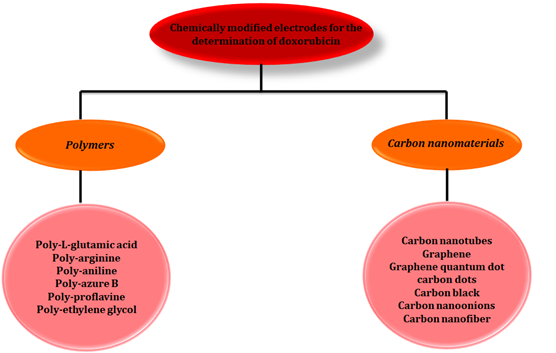
Abstract Cancer, is a worldwide epidemic, is characterized by the abnormal growth of cells and their ability to spread to various organs and tissues within the body. Doxorubicin (DOX) is an effective chemotherapy drug that not only inhibits the growth of cancer cells, but also assists in the immune-mediated elimination of tumor cells. Hence, it is critical to carefully regulate the DOX dosage for cancer patients undergoing drug-based cancer treatment. Nowadays, electrochemical sensors have emerged as reliable analytical instruments for detecting a broad spectrum of target molecules. This is because of their simplicity, affordability, and ability to seamlessly integrate with multiplexed and point-of-care strategies. By modifying the surface of electrodes with diverse materials, it is possible to enhance the sensitivity and lower the detection limits (LOD) of electrochemical sensors. This report provides a concise summary of selected studies that focus on the use of electrochemical sensors based on carbon nanomaterials and polymers for the DOX analysis, and offers insights on the technical advancements and potential future applications in this particular domain.